Danny Satchell's body of work, shown as his solo exhibition The Floating World at Islington Mill, draws on a stretch of his life that ran between hedonistic pursuit and convalescence. In his early twenties he counted a five-in-the-morning finish an early night. Some years later, after a summer of not looking after himself and the start of a new job, he ignored a bout of flu and spent three days in hospital with pneumonia. Recovery took months, and for most of them he could not paint. The work comes out of the first period and was only possible because of the second.
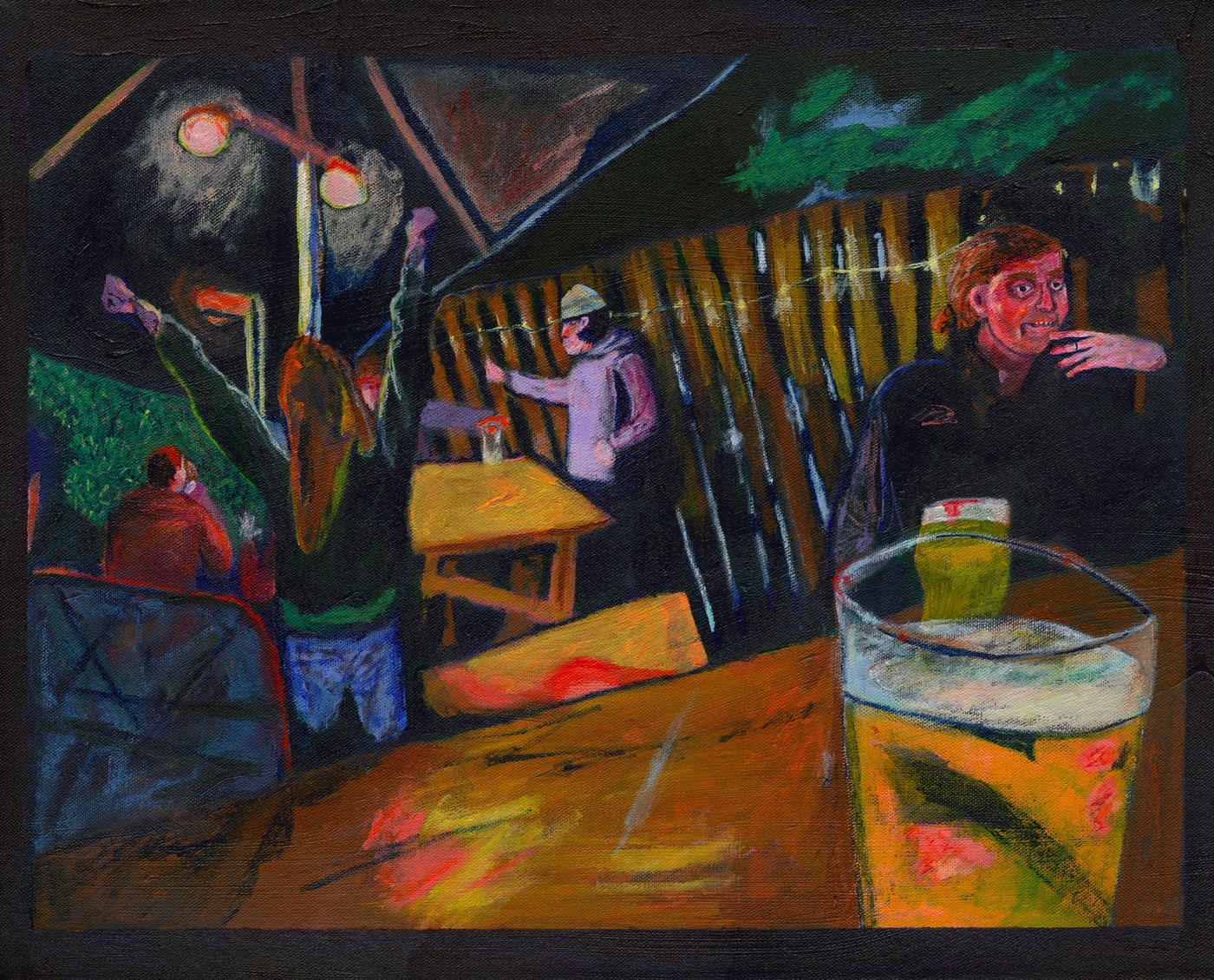
Satchell paints snapshots of Manchester nightlife. The Floating World, which gives the show its name, puts a half-finished pint at the front of the painting, slightly out of register with the beer garden behind it. It is a vantage point rarely encountered in painting, and one only a phone camera produces: a POV shot from the midway point of a night out. The glass is not a still life, and it is not a symbol. It is the nearest object to the lens, warped by the limitations of the camera. Limitations Satchell has stayed loyal to rather than corrected.
That loyalty is what earns the title. Ukiyo, translated as the floating world, describes the urban pleasure culture of Edo-period Japan, from the early seventeenth century until 1868. But the debt is structural rather than atmospheric. Ukiyo-e built its compositions the same way: Hiroshige dropping a plum branch flat across the front of the picture plane, a bridge in sudden rain cropped by the frame, flattened planes of unmixed colour, night subjects, steep contrast. Van Gogh copied those prints; the Impressionists took the cropping and kept it. Satchell arrives at the same structure from the opposite direction, through a camera held at table height rather than a woodblock. The floating world of his title is not a mood borrowed from Edo. It is a way of cutting a picture.
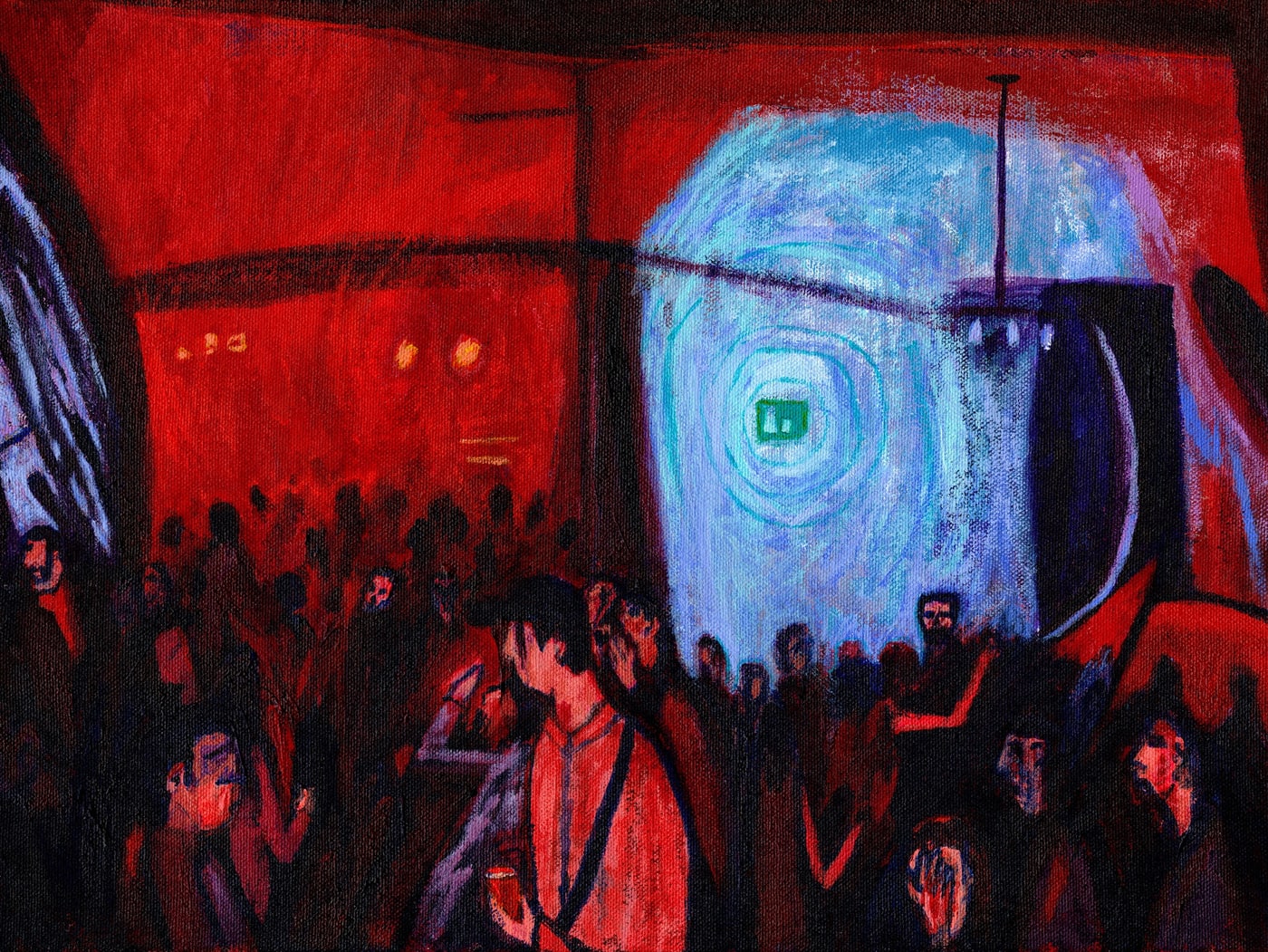
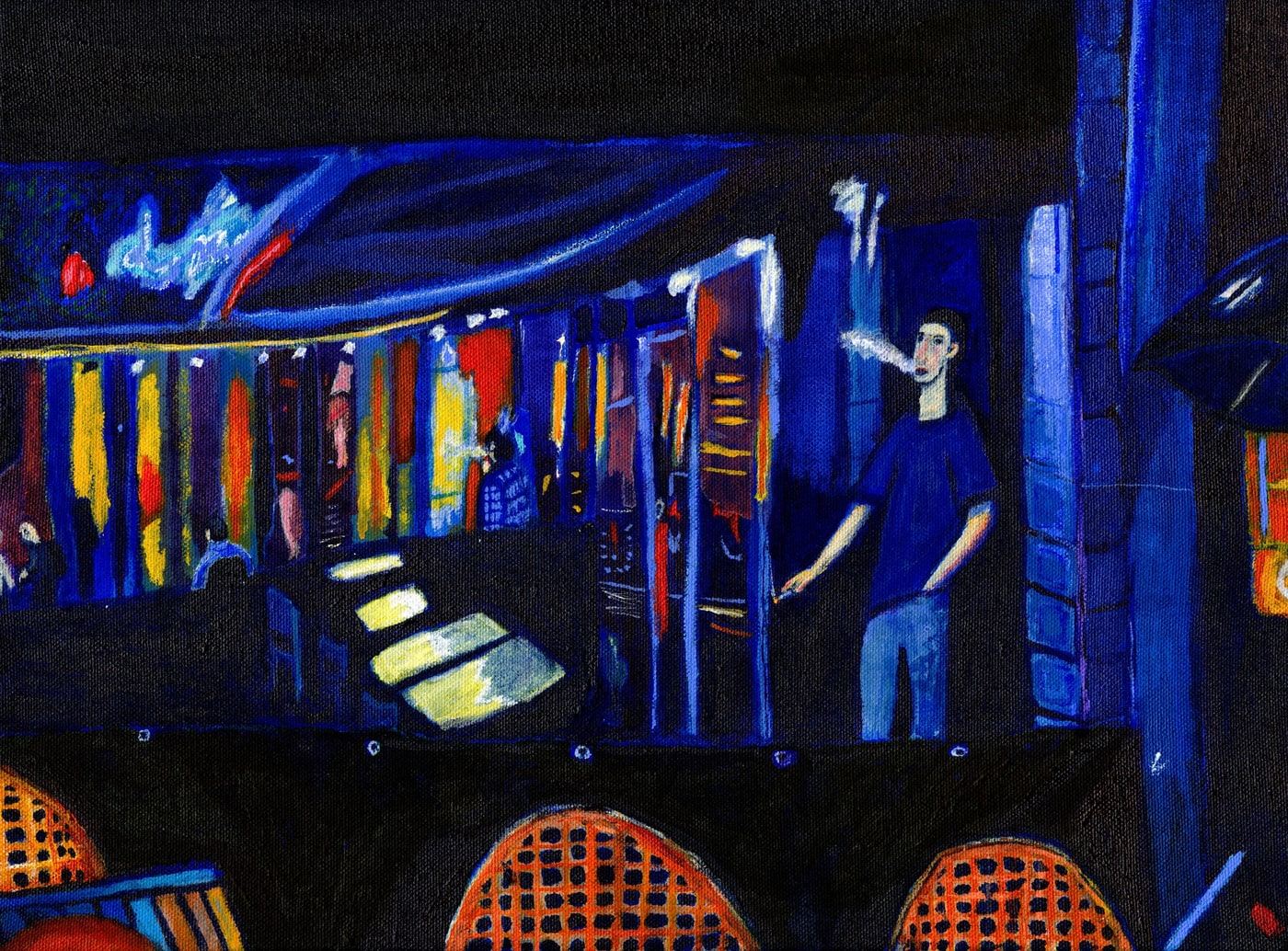
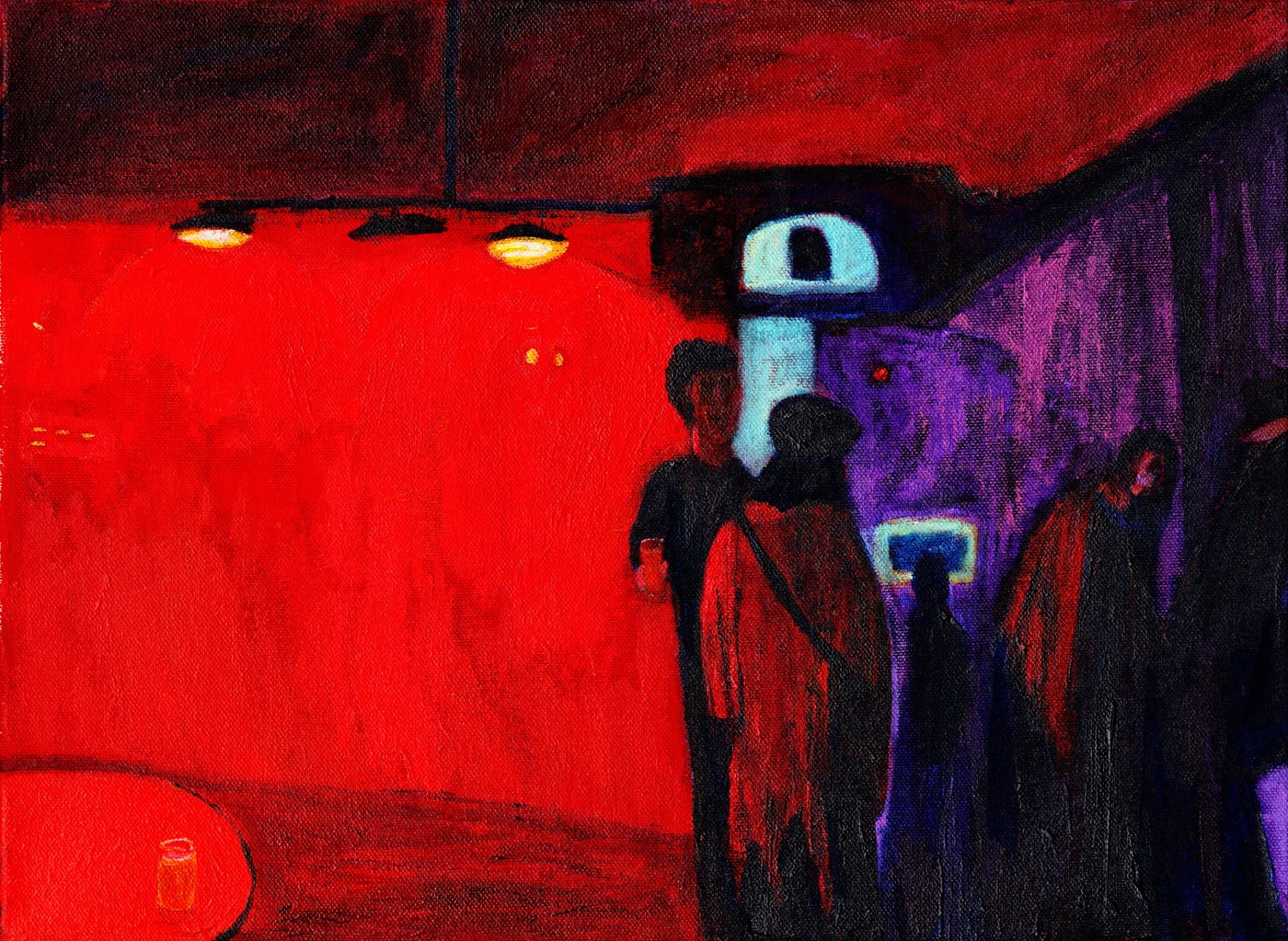
Light is the subject here. Painters have worked nightlife since the gas lamps, but that light remained true to the colours of the natural world despite being tinged with a warm yellow. Van Gogh’s The Night Café turns on red walls against a green ceiling; the barmaid in Manet’s A Bar at the Folies-Bergère stands over a counter where the oranges, the flowers and the green bottle are all still themselves. A gelled wash does not allow that. It is monochromatic by design: under saturated red, skin, denim and glass stop having colours of their own and become values of one. Each canvas gets a single hue to work with. Blue on Blue keeps to one blue, lit by backlit strips above a terrace. Broken Smoke Machine runs red into purple, three lamps along a ceiling, a fog machine glowing white and useless in the corner. Red Rum gives a gig crowd almost nothing but red, a projection burning blue-white behind it. Broken Smoke Machine and Red Rum are both set in the Derby Brewery Arms in Cheetham Hill. The Floating World is sodium orange, held together by a string of bulbs along the slatted fence of The Rose and Monkey’s beer garden. None of these colours was a painter’s decision. They were set at a lighting desk before he arrived, and Satchell has taken them as he found them.
Faces appear only where the light happens to fall. Most of the figures stay silhouettes, turned away, mid-gesture, busy with each other. Except one. The man at the right of The Floating World looks directly out, hand at his jaw, caught between a smile and something harder to name. He is the only person in these paintings who knows he is being looked at, and the painting is built so that the viewer meets him over the top of their own drink. The night carries on behind him. He has stopped to see who is watching.
Satchell takes his title from Kazuo Ishiguro as much as from Edo. An Artist of the Floating World follows Masuji Ono, a painter in post-war Japan reckoning with his contribution to the imperialist cause, and its real subject is memory and the ways a person's own memory leads them astray. In one scene Ono's mentor dismisses his new work for celebrating the path Japan was taking, and sets his own position against it: that painting should document the nightlife of the floating world. The drinking and the partying. The endless nights, the friends, the strangers.
Satchell’s paintings reconstruct and mediate memory. They are built from photographs shot by someone already inside the evening. He describes those hours as living “so vividly in my mind but I could never go back to”. But Ono’s guilt does not follow him. Satchell memorialises the fleeting beauty of his own nights, and the only thing he has lost is the ability to return.
The Floating World is on view at Islington Mill, James Street, Salford M3 5HW, on 21 and 22 November 2026, 12pm to 6pm, with a preview on Friday 20 November from 6pm.
Responses.
Received. Thank you.