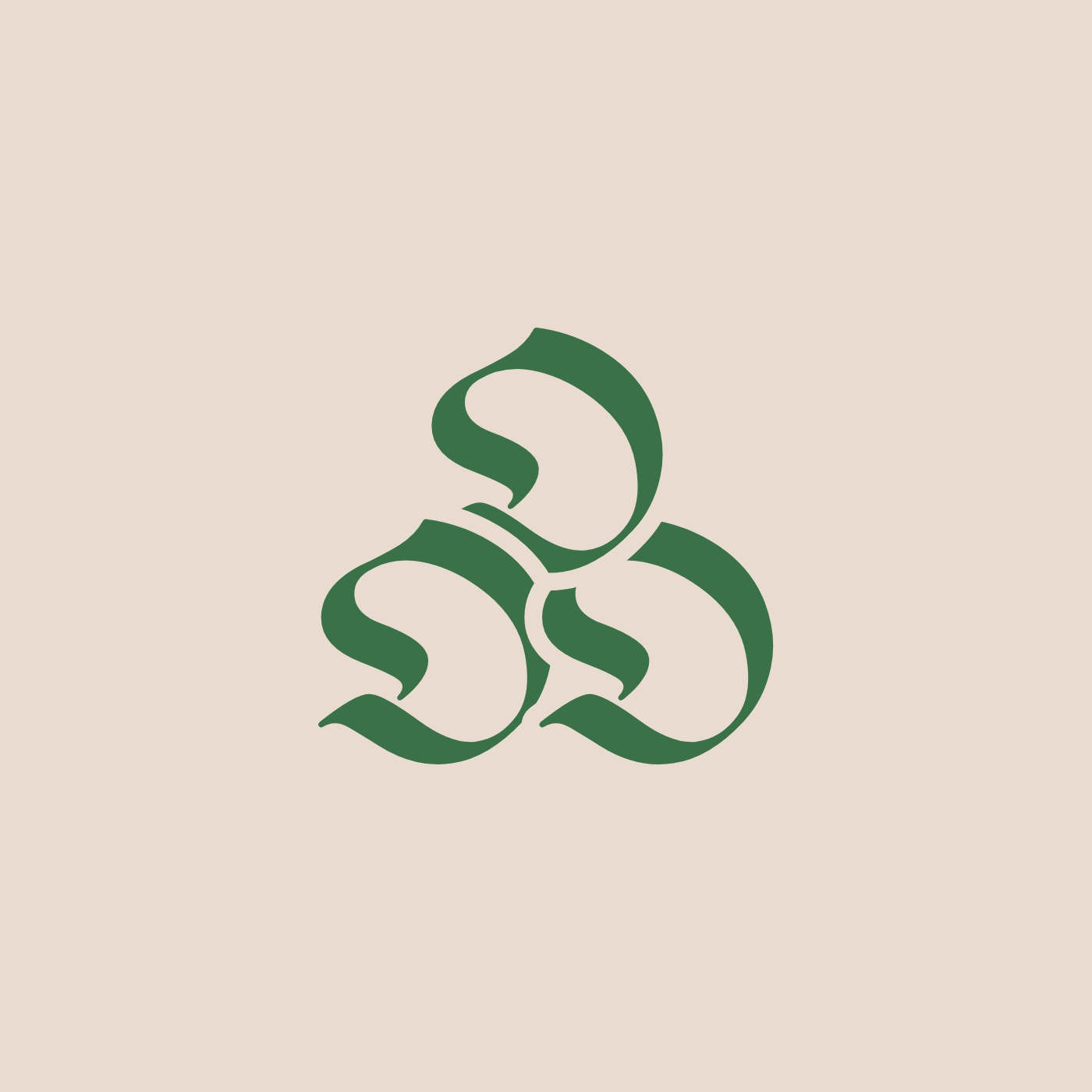
For most of the time 000 has existed, its mark has been three blackletter O's standing in a triangle, each a little apart from the others. It said who we were. It said nothing about what holds us together.
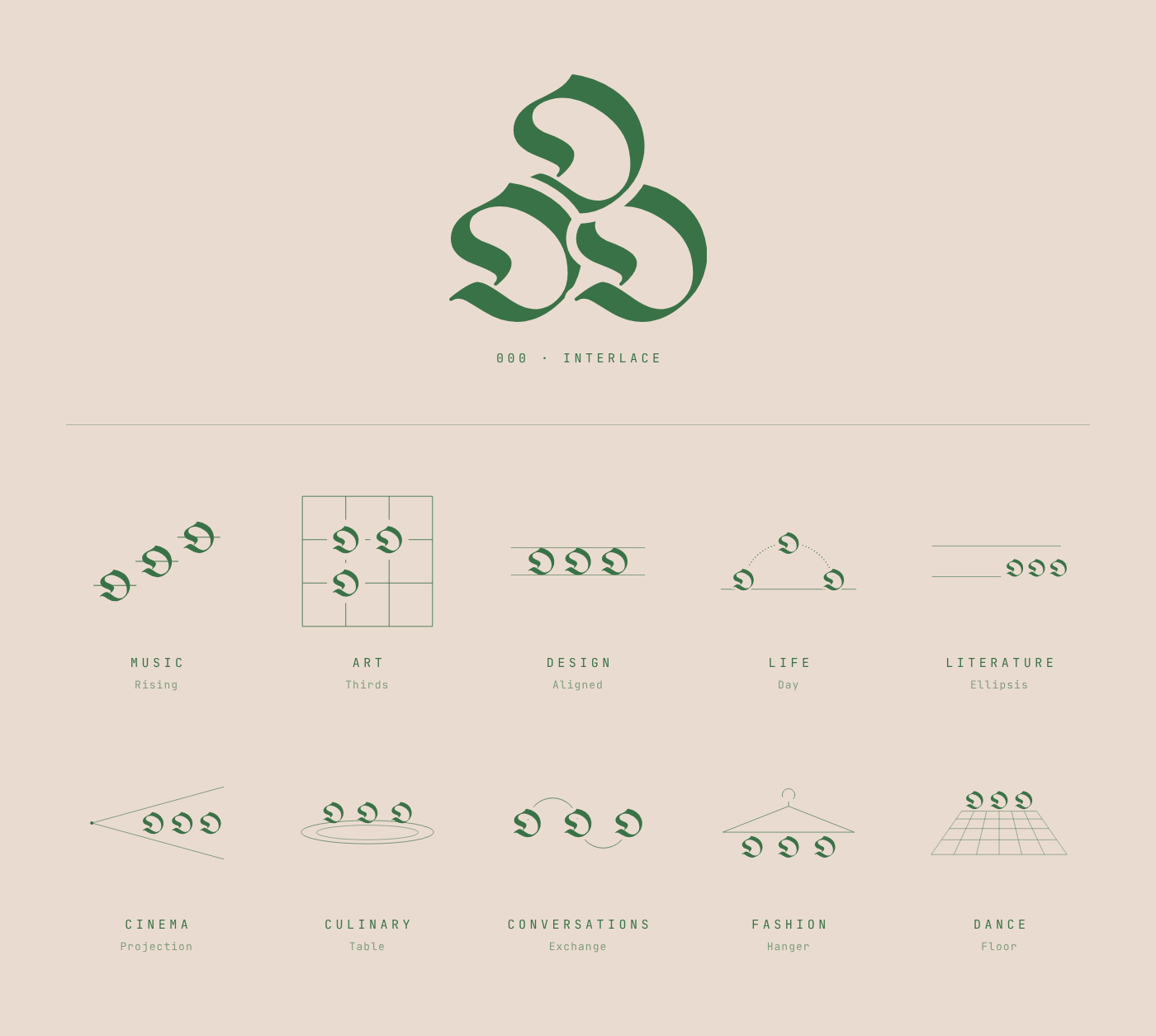
The new mark keeps the three O's and changes one thing: they now pass through one another. Each O runs over the next and under the one after, all the way round. Mathematicians call this arrangement the Borromean rings. No two of the three are linked, and yet the three cannot be pulled apart; take any one away and the other two fall free. I do not know a better description of a collective. Nobody is chained to anybody. The whole holds only because each one stays.
The letter itself has not changed. It is the same capital O that has been on every card. We changed only how the three hold each other, and that became the rule for everything that came with it. Each of the ten divisions now has its own mark, and in every one the O stays exactly as it is; only the arrangement moves. In Music the three climb, each on its own ledger line. In Art they sit where the thirds of a canvas cross. In Literature they trail off the end of a sentence, as an ellipsis does.
You will still find the old triangle on our earlier posts. They stay as they went out: a record should not be rewritten to flatter the present. Since 30 September the woven mark has been on the site and on every link we share. Each division's mark heads its page, every piece we share from it, and our cards, and on the homepage the mark turns through all ten divisions in turn.
Look closely at where one O crosses another. There is a small gap there, a breath of ground between the strokes. That gap is what turns three overlapping letters into a weave, and it is the part of the mark I care about most.
Responses.
Received. Thank you.