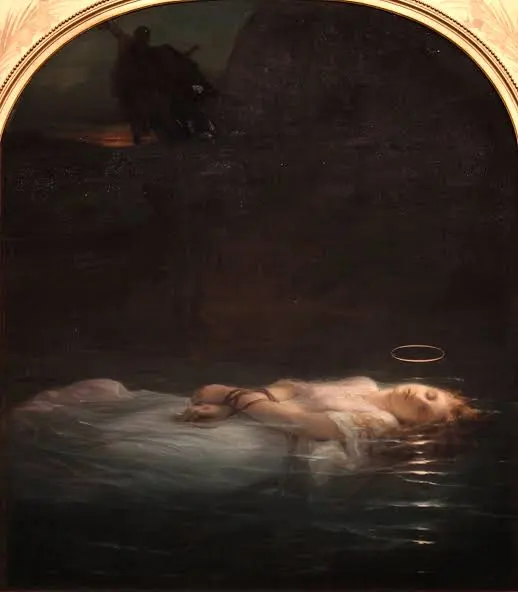
The Young Martyr, known in French as La Jeune Martyre, painted in 1855, is Paul Delaroche's last major work. It hangs in the Musée du Louvre, Paris: oil on canvas, 170.5 by 148 centimetres. Delaroche died the following year, mid-way through a new series on the life of the Virgin.
The subject is a nameless young Christian woman, hands bound, set adrift on the Tiber and drowned for refusing to renounce her faith, an episode from the persecution of Christians under the Roman emperor Diocletian. The painting's exact literary source isn't settled; Chateaubriand's name comes up in some accounts of it, but nothing ties his writing to this scene precisely enough to state as fact. Delaroche paints the moment her body is found: mourners gather in shadow on the riverbank above, grieving over what the water below has already claimed.
A halo, drawn as a thin, near-graphic ring rather than a solid disc, floats just above her head, the one hard-edged mark in a canvas built from drift and shadow. It reads less like a supernatural event than a single point of certainty placed inside all that ambiguity, though that is a reading, not a fact the painting states outright.
Delaroche had lost his wife, Louise Vernet, a decade earlier, in 1845; by most accounts he never fully set the grief aside. Whether that shaped this particular canvas is Delaroche's to know, not ours, but the correspondence between a young life ended and an old one still mourning is hard to unsee once you know it. An earlier version of the composition, painted in 1853, hangs in the Hermitage in St Petersburg.
Responses.
Received. Thank you.