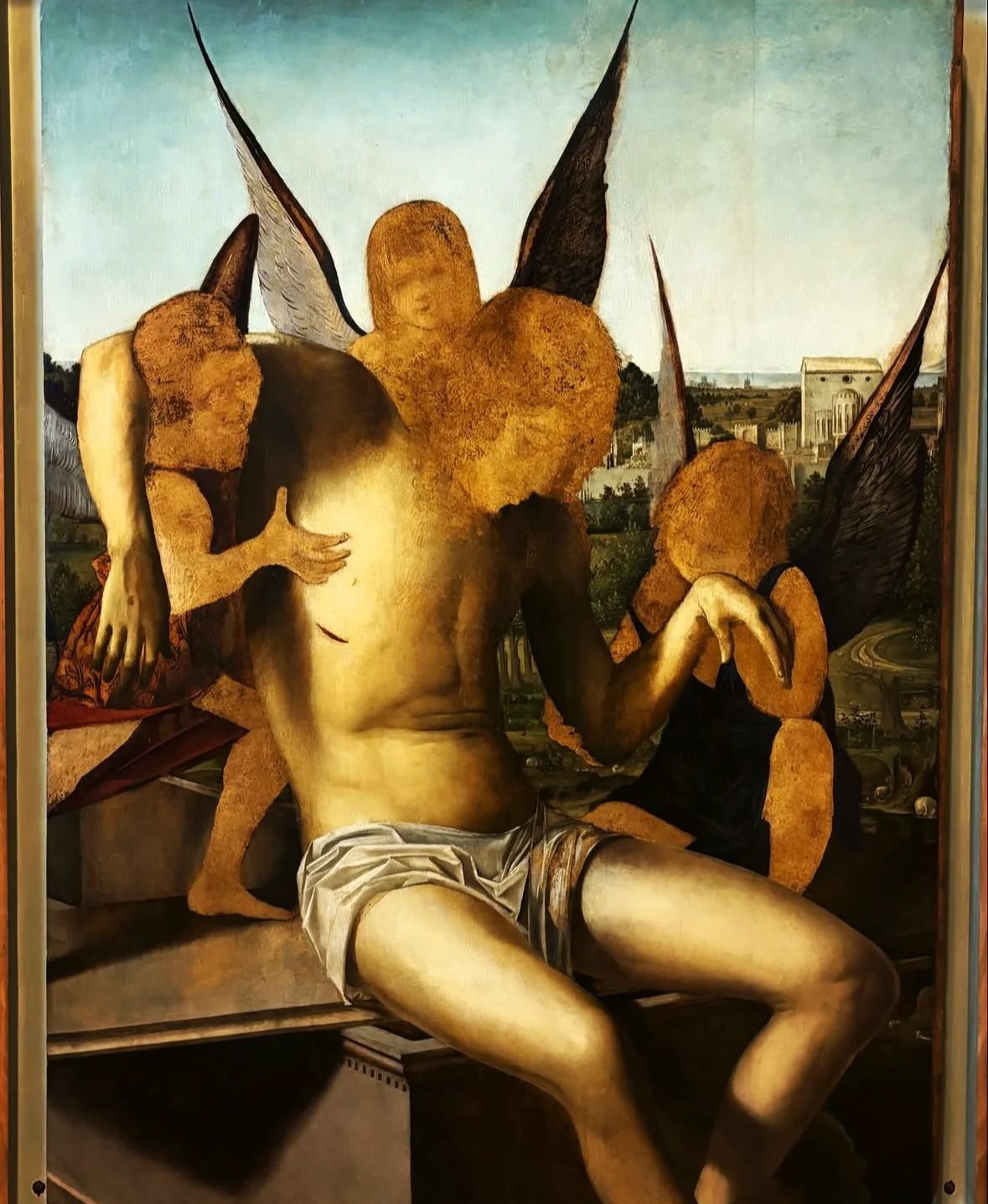
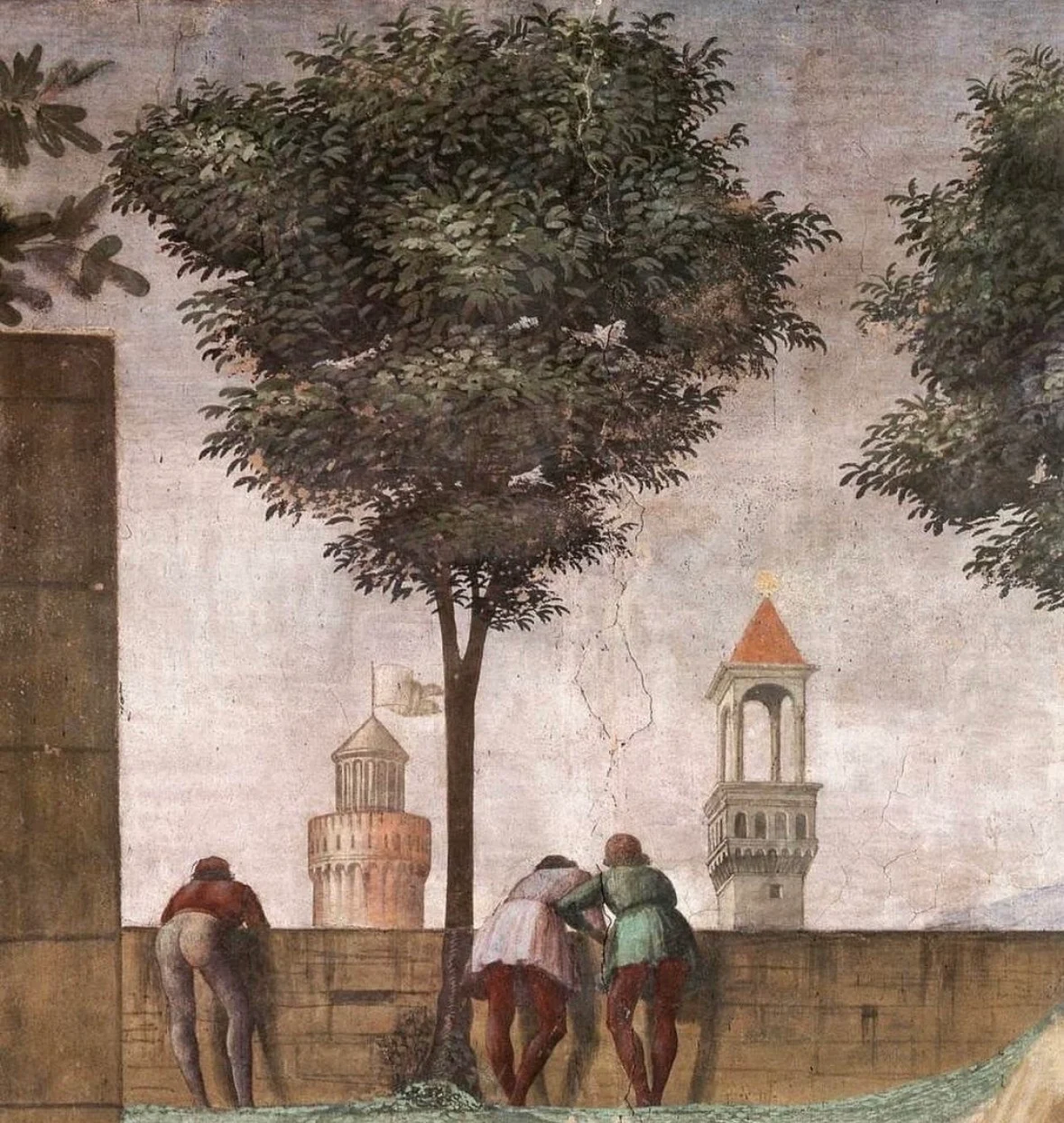
Two paintings, separated by a decade and a thousand kilometres of road. Antonello da Messina's Dead Christ Supported by Three Angels (c. 1476) and a wall-section detail from Domenico Ghirlandaio's The Visitation (1486 to 1490). Both are devotional in nominal subject. Both, on closer reading, hand the picture's most instructive material to the figures and surfaces at the edge of what the doctrine is trying to say.
The Antonello is the more obvious case, because the disturbance is inside the bodies themselves. The torso of Christ is rendered with an anatomical clarity that shows Antonello's debt to Flemish oil technique as much as to Italian disegno: he was, more than almost any other painter of his generation, the conduit between the two traditions. The flesh is a material fact. There is no sentimentality in the modelling and the wound on the side is almost a parenthetical mark, understated to the point of being missable. Then the angels. Their faces, their flesh, are eroded. Whether by the deliberate scoring of a later hand, by chemical deterioration of the pigment, or by the artist's own choice to leave the divine intermediaries less finished than the human body they support, the effect is the same: the divine is dissolving while the dead body retains its sculptural clarity. The composition is vertically compressed. There is no graceful middle distance between viewer and corpse. You are forced into proximity with the dead weight. The Italianate landscape behind, the soft greens and the distant architecture, refuses to soften this. It carries on, indifferent.
That indifference is the bridge to the Ghirlandaio. The image we have here is a wall-section detail from the larger fresco of The Visitation, the sacred meeting of Mary and Elizabeth. None of that meeting is in the frame. What is in the frame is the background work. Three figures lean on a wall, looking out at something the painting will not show us. They are wholly uninterested in whatever sacred narrative is unfolding in the foreground of the full composition. They exist in their own temporal register, which is to say the register of fifteenth-century Florentine daily life: a city we can recognise from the campanile, the rotunda, the Tuscan cypress at the centre of the frame. Ghirlandaio's craft, his particular advantage, was the ability to embed the quotidian directly inside the sacred without making the sacred ridiculous. He simply lets the world keep running.
The tree is doing real structural work. It bisects the composition, separating the two architectural elements, anchoring the middle ground, giving the eye a vertical axis around which the rest of the scene can settle. And then, layered on top of all of it, the cracking. The plaster has split. The fresco is itself a record of time passing, ageing on the wall it was painted into, in a way that an oil panel cannot age. Fresco is the most honest medium the Renaissance had: it cannot lie about its surface, because its surface is the wall. Five hundred years of weather, sunlight, and Florentine air are visible in the composition now, and the painting is no less itself for showing them.
Read together, the two works share a single argument. The sacred at its centre is doctrine. The sacred at its edges is material: pigment, plaster, anatomy, the indifference of bystanders, the fact of time. Antonello tells us that flesh outlasts theology in the painting that contains them both. Ghirlandaio tells us that the world goes on around the miracle whether the miracle is looking at us or not. In each case the painter has put the load-bearing observation in the place the eye is not trained to look. That is where the painting is honest. That is where the painting still has something to teach a viewer who has been schooled by the algorithm to look only at the centred, the legible, the optimised image.
Stand close to either of these. Then stand to the side of either of these. The painting that can survive both readings is the painting that was made well.
Responses.
Received. Thank you.