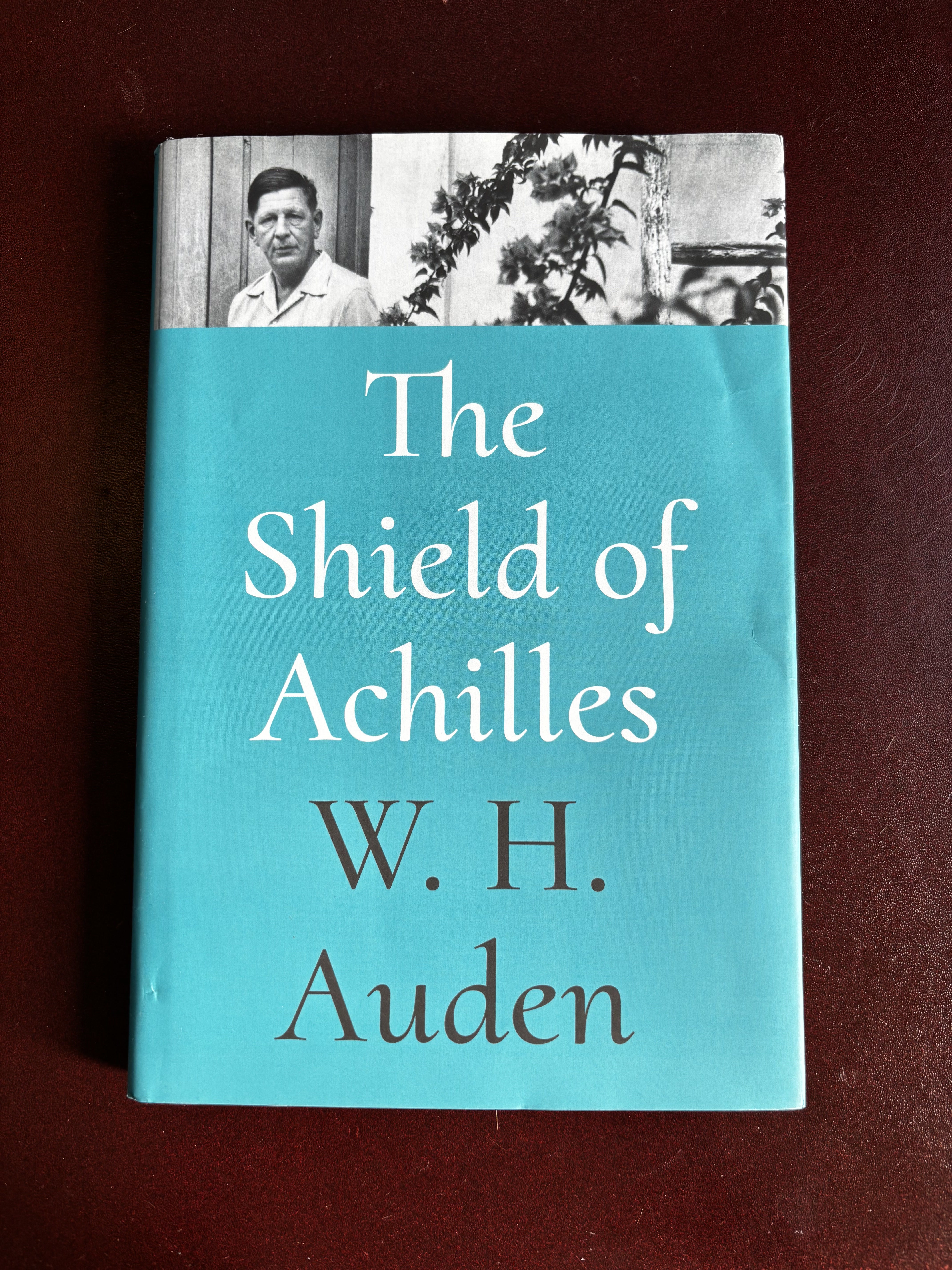
W.H. Auden's The Shield of Achilles (1955) is arguably his most tightly unified collection, and won the US National Book Award for Poetry in 1956. It gathers work from 1951 to 1954 into three movements: the "Bucolics" sequence, a set of miscellaneous middle poems, and the closing "Horae Canonicae" sequence, which restages the Crucifixion across the medieval prayer hours. The title poem sits between the two sequences, and is the hinge the whole book turns on.
The poem is a direct provocation to Homer. Book 18 of the Iliad contains one of the most celebrated passages in Western literature: Hephaestus forging Achilles a new shield, decorated with a kind of cosmography of civilisation, cities at peace and at war, a wedding, a harvest, dancing. Auden restages the exact same scene, Thetis watching over the smith's shoulder, hoping to see that same abundance for her son, and refuses her, three times over.
Short, three-line stanzas voice Thetis's expectation; the longer stanzas describe what Hephaestos actually forges instead: a flat, featureless plain, ranked columns of marching men, and, most memorably, a bureaucratised execution: "Barbed wire enclosed an arbitrary spot / Where bored officials lounged (one cracked a joke) / And sentries sweated for the day was hot: / A crowd of ordinary decent folk / Watched from without and neither moved nor spoke." The officials are bored, not monstrous. The crowd is decent, and does nothing.
The poem closes by turning the irony back on Thetis herself, forging a weapon for a killer: "Iron-hearted, man-slaying Achilles / Who would not live long." Her dismay is naive on its own terms. The grim modern shield is arguably the more honest object, truer to what Achilles is actually for than the pastoral idyll she wanted.
000's reading: Auden isn't arguing that war is hell, he's arguing something colder, that modern violence has become procedural, administered rather than heroic, and that the old civic imagery Homer used to hold a culture together no longer applies. Written in 1952, close enough to the war and the camps, and inside the first nuclear arms race, to read as a direct argument about what industrialised violence does to inherited ideals.
Responses.
Received. Thank you.