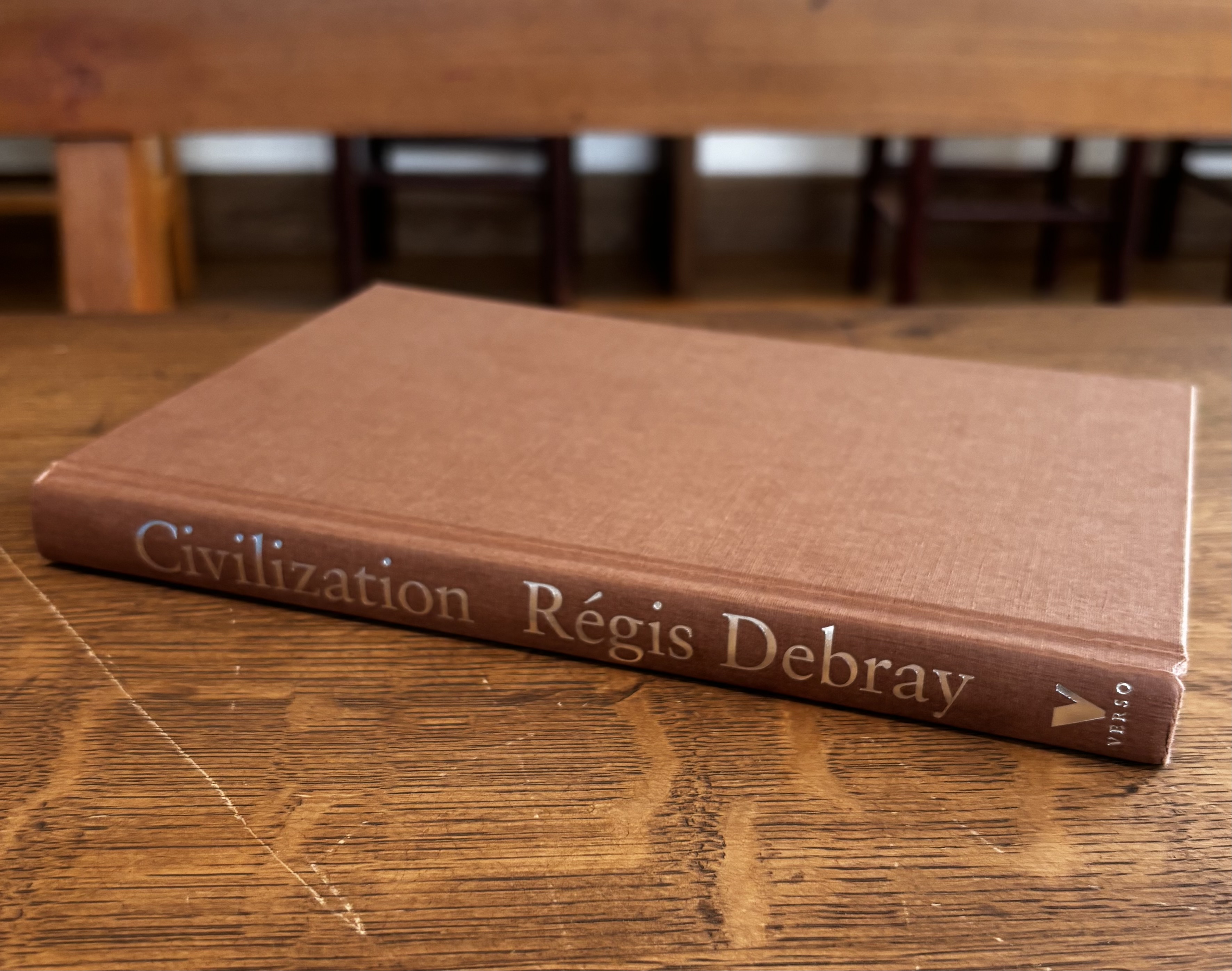
Régis Debray's Civilization: How We All Became American, published by Verso in 2019 and translated by David Fernbach, appeared two years after its French original, Civilisation: comment nous sommes devenus américains, published by Gallimard in 2017. The premise sounds like a provocation and turns out to be an argument: that the twentieth century's real victor was not a country but a way of organising time, space and appetite, and that way now has a name, and the name is American.

Debray is an unlikely person to make this argument from inside a paperback. Born in Paris in 1940 and trained at the École Normale Supérieure under Louis Althusser, he was teaching philosophy in Havana by the late 1960s and was in Bolivia with Che Guevara's guerrilla column soon after. Arrested in 1967, he was sentenced to thirty years in prison; an international campaign, with Sartre and de Gaulle among the names attached to it, secured his release in 1970. He returned to France, and from 1981 served as François Mitterrand's adviser on foreign affairs, tasked partly with loosening France's dependence on the United States. He is also the inventor of mediology, his own discipline for studying how cultural meaning is carried materially across time, not just believed. Nobody arrives at this book's argument casually.
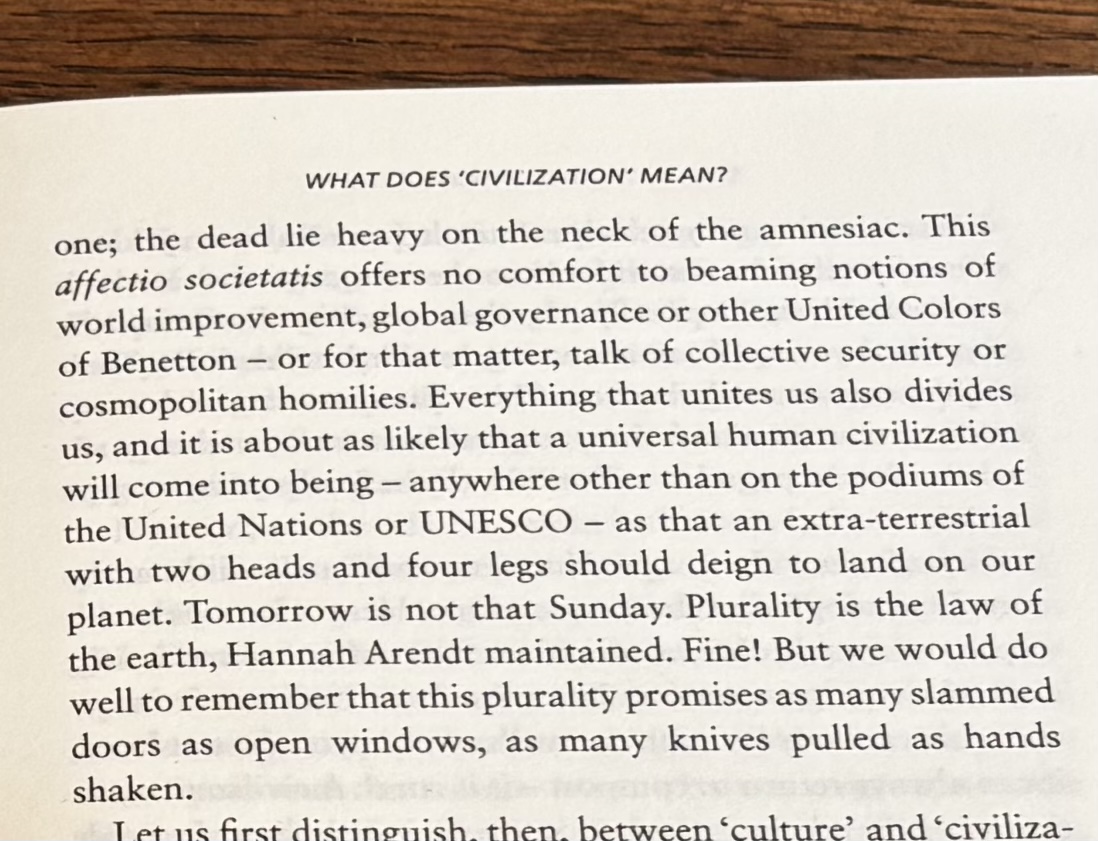
The distinction the whole book turns on is old, but Debray restates it with some force: a culture constructs sites, he writes, a civilisation builds roads. Culture is rooted and particular, a soil that produces one wine and not another. Civilisation is a network: it does not need to be loved, only connected to, and it spreads by armies, fleets and, he notes, drones as readily as by ideas. He traces the word "civilisation" to Mirabeau and Voltaire, who coined it as the Enlightenment's exit door from Barbarism, and from there to the later German split between Kultur, living and particular, and Zivilisation, portable and inert, a distinction he credits Lévi-Strauss with restating in anthropological terms: culture as the attitudes and skills a society teaches its members, learned rather than built.
Debray gives the mechanism its own grammar, three terms in a determining sequence: imperium, the empire itself, emprise, the hold or influence it exerts once the conquering stops, and empreinte, the imprint or trace left behind after both have gone. "A supremacy is established," he writes, "when the imprint survives the impress, and the impress the imperium." Rome is one of the cases he tests it against. It reads, unavoidably, as a description of the exact order in which he thinks American power is now spending itself: empire first, then influence, and last of all, longest of all, the imprint.
Having drawn the line, Debray spends the rest of the book arguing that one side has swallowed the other. His index case is a single reversal: in 1900, he writes, an American of taste was a European in exile; by 2000, a fashionable European is a frustrated American, or one still waiting on a visa. He reduces American civilisation to three fetishes, space, image and happiness, set against a European civilisation of time and writing, and points to "globish", a word for the American-English vocabulary that has colonised every other European tongue, as the symptom that confirms the diagnosis. His one offered way out looks backward rather than forward: Vienna at the cusp of the twentieth century, excluded from the German Reich, its own empire visibly declining, yet still a hothouse for art and literature. A demoted culture, he suggests, can still be a fertile one. He does not sound entirely convinced by his own consolation.
000's interest in the sites-and-roads line runs past Debray's own argument, which is about geopolitics, not feeds. But a culture that constructs sites and a civilisation that builds roads is also a fair description of the difference between a body of work and a scroll: one is rooted somewhere and asks you to slow down for it, the other only wants you connected, moving. Debray isn't making that argument here. It is just difficult to read the line and not make it yourself.
Responses.
Received. Thank you.
“ Debray is an unlikely person to make this argument from inside a paperback” - I didn’t get why
Gabs ·
Two things really... He spent his twenties fighting with Che Guevara in Bolivia, did thirty years for it, then ended up advising a French President, so his whole life was ACTION, and here is making his case in a more quiet paperback instead. That's one irony. The bigger one: the argument itself, that local culture is losing out to one big global way of life, sounds like something a conservative worried about lost tradition would say (i.e., MAGA), not a Marxist revolutionary. The politics and the argument are pulling in opposite directions. For me, that's the "unlikely person" part.
Michael ·