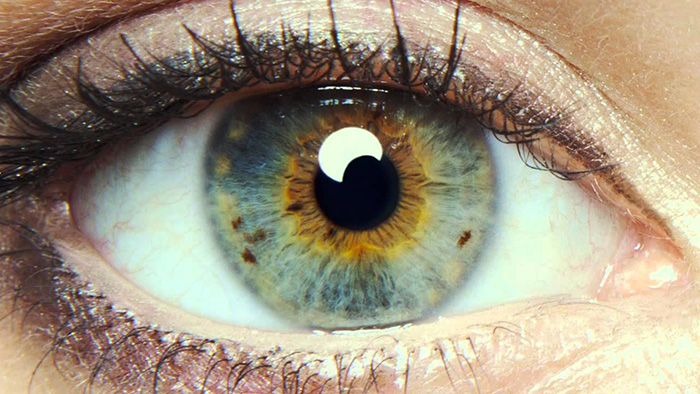
Every living person on this planet has their own unique pair of eyes. Each their own universe.
This is a film built on a single, very simple biological fact: the human eye. We evolved eyes to survive: to spot the predator at the edge of the grass, to find the ripe fruit, to read the weather. That is the answer the textbook gives. But anyone who has ever held another person's gaze knows the eye has a second job, one no anatomy chart names. To connect. To see, and to be seen. To let something of the soul cross the small distance between two faces, and to see worlds beyond the physical one we walk through.
That is the question Mike Cahill puts inside a science film. Ian, a molecular biologist played by Michael Pitt, is mapping the evolution of the eye to settle an old argument: that nothing about us required design, that every iris is just chemistry and time. Then at a party he meets a young woman whose eyes he has never seen on anyone else. He photographs them. He loses her. He builds a life around what he has lost.
What I love is the film's refusal to flatten its own question. Cahill films science with the same patience he films grief. The lab and the cathedral occupy the same frame. There is no winking, no eye-rolling on either side. Ian is a scientist and he is also a man in love, and the film never asks him to choose which one is real.
The second half moves to India, and this is where I Origins risks losing some viewers. A possible reincarnation, traced through iris patterns. A child whose eyes match those of a woman dead seven years. It is the kind of plot that could collapse into either mysticism or sentiment, and somehow it does neither. Cahill keeps it documentary-flat. He lets you decide what you saw.
Sofi, played by Astrid Bergès-Frisbey, lives by the opposite principle to Ian's: trust the strange, trust what arrives unannounced. The film does not choose between them. It just shows you the size of the territory between two people who love each other and look at the world through completely different equipment.
I came out of it wanting to call someone. Not to argue. Just to say: look again.
Responses.
Received. Thank you.