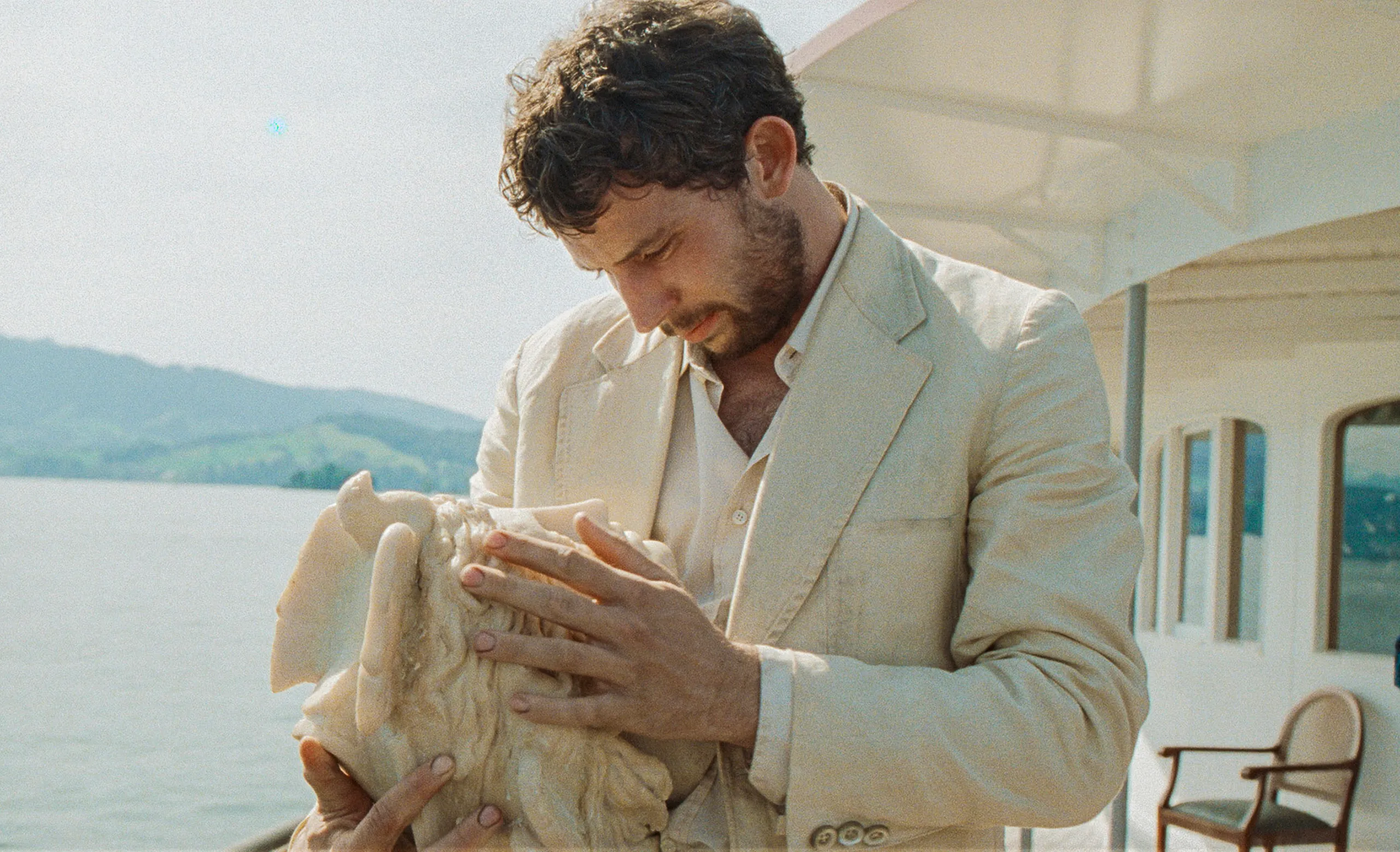
A British archaeologist is released from an Italian prison and returns to a small town in central Italy, on the Tyrrhenian coast, where he once lived, loved, and dug. Arthur has a gift: he can sense the locations of Etruscan tombs buried beneath the earth. He uses this gift to rob them. He sells what he finds to a dealer named Spartaco. He does all of this while searching for a woman who is already dead.
Alice Rohrwacher's La Chimera (2023) operates on two planes simultaneously. On the surface, it is a heist film set in the Italian countryside of the 1980s, populated by a ragged crew of tomb raiders who treat antiquity as inventory. Beneath that surface, it is a film about what happens when longing replaces presence as the organising principle of a life. Arthur does not dig for profit. He digs because the underground is the only place where absence feels like proximity.
The Etruscan artefacts Arthur unearths were made by people who understood death as a continuation, not a termination. Their tombs were furnished for ongoing life. Rohrwacher frames the grave robbers' work as a perverse inversion of that belief: stripping the dead of their provisions, extracting value from a worldview they cannot comprehend. The parallel to contemporary extraction economies is not subtle, but it does not need to be. The film earns its metaphor by never insisting on it.
Josh O'Connor plays Arthur as a man whose body is present but whose attention is permanently elsewhere. He walks the landscape like someone reading a map that only he can see. Isabella Rossellini, as Flora, anchors the film's emotional weight with a performance built entirely on what is not said. Carol Duarte, as Italia, offers Arthur the possibility of a life lived in the present tense. He cannot take it. He is too committed to absence.
Rohrwacher and her cinematographer Hélène Louvart shot on a deliberate mix of Super 16mm, regular 16mm, and 35mm, switching format and aspect ratio between Arthur's daily life, the Etruscan underworld, and his flashbacks of Beniamina. The grain, the warmth, the slight instability of the image: it all reads as a refusal of digital clarity. This is a film that does not want to be consumed in high definition. It wants to be felt at the edges, the way Arthur feels the presence of tombs beneath his feet.
Responses.
Received. Thank you.