Art
Botero Was in New York
Ref. 000-ART-BOTERO
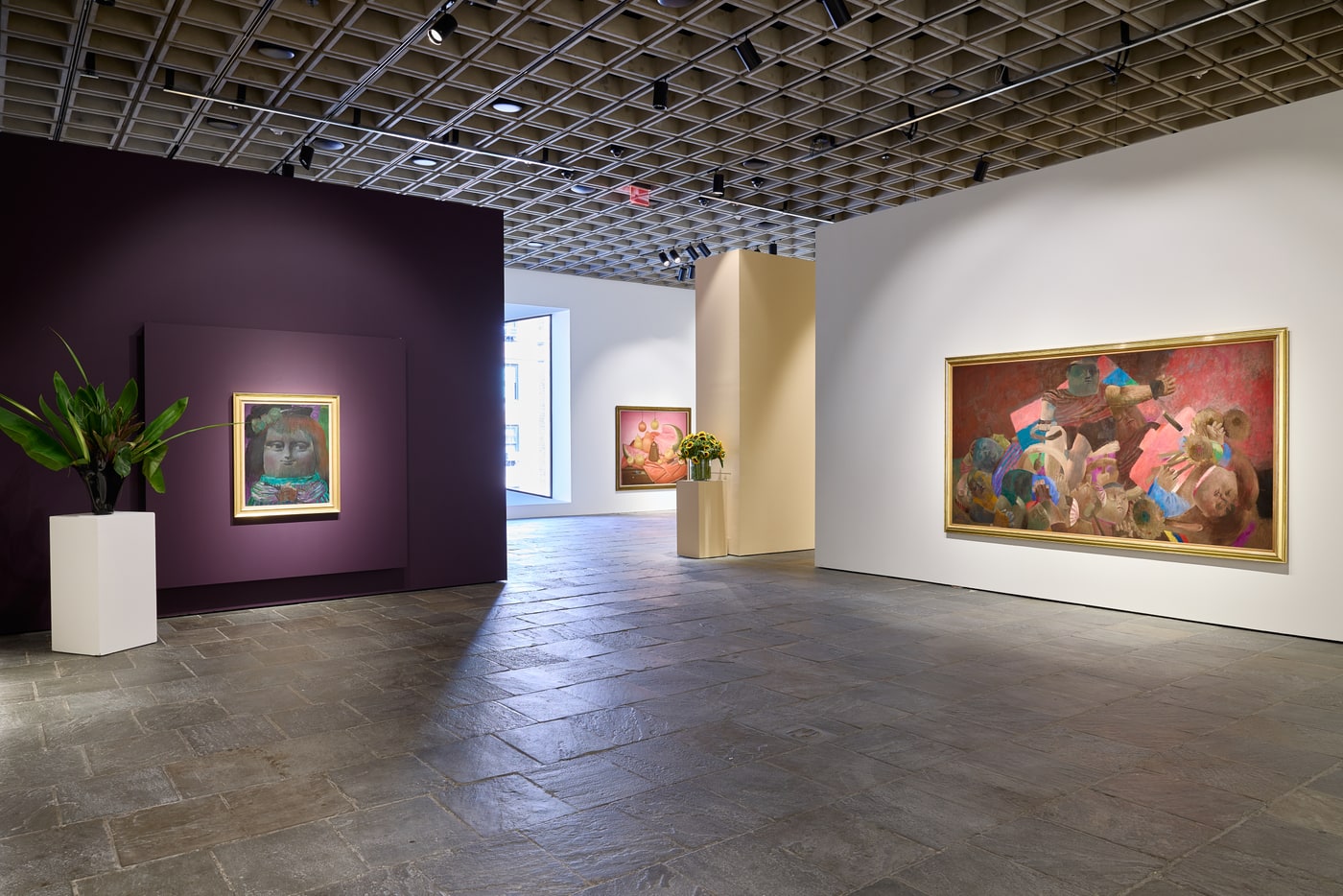
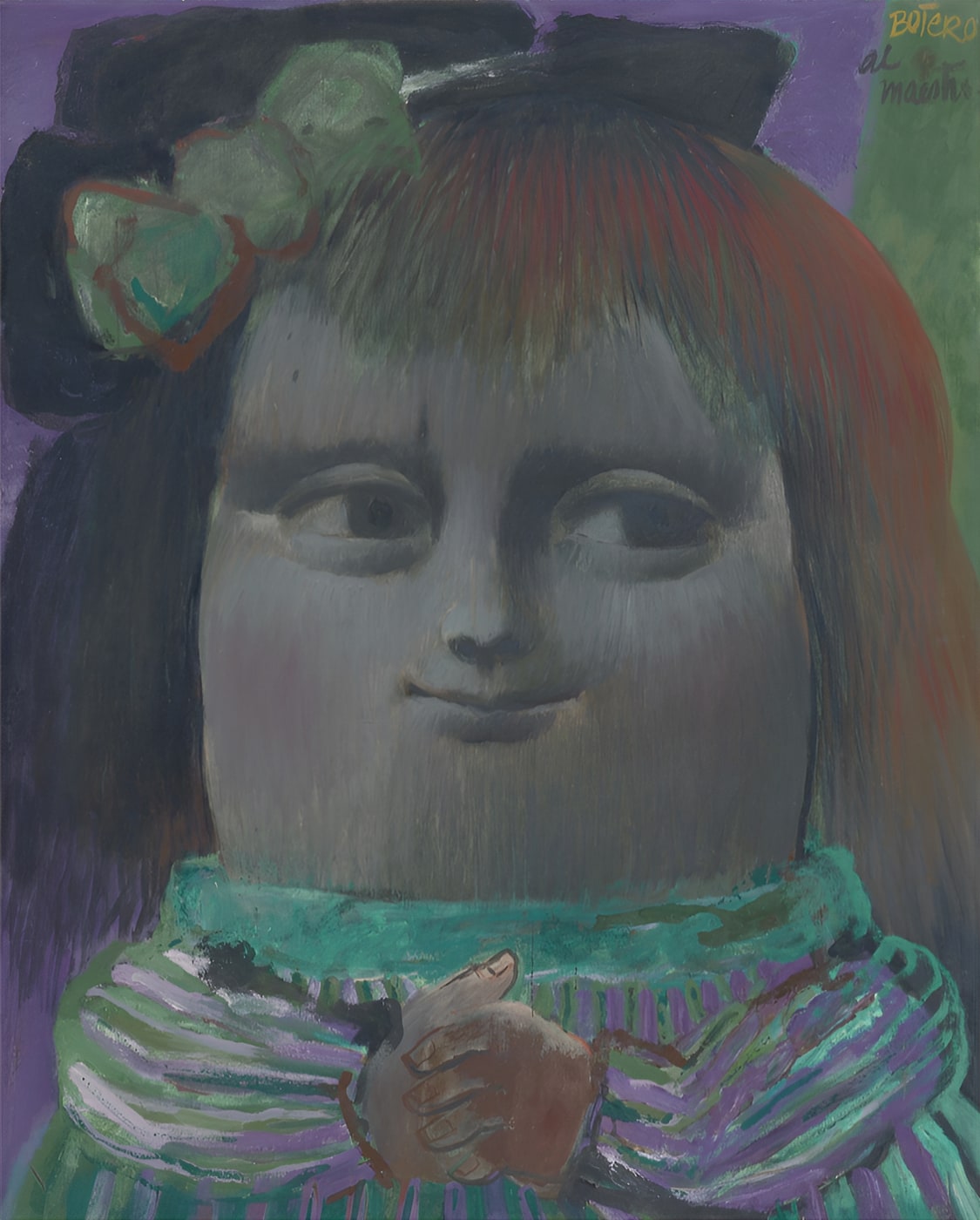
How long does it take to realise you are looking at a painting by Fernando Botero? Botero arrived in New York in 1960, into a city dominated by Abstract Expressionism. He called what he was up against the "dictatorship of abstract art." He tries abstraction but can't leave the figure behind. Apotheosis of Ramón Hoyos, 1959, painted the year before, insists on figuration against the grain of the NY scene. Botero was living in a Greenwich Village building full of painters when Dorothy Miller of MoMA wandered into his studio. She left with Mona Lisa, Age Twelve, 1959. His first institutional acquisition, and it happened by accident. By 1972, his debut at Marlborough Gallery sold out. Twelve years of resistance, vindicated in one show. Through to 1973, this resistance matures into the recognisable "Boterismo". But Boterismo doesn't reject the old masters; it's a running conversation with them.
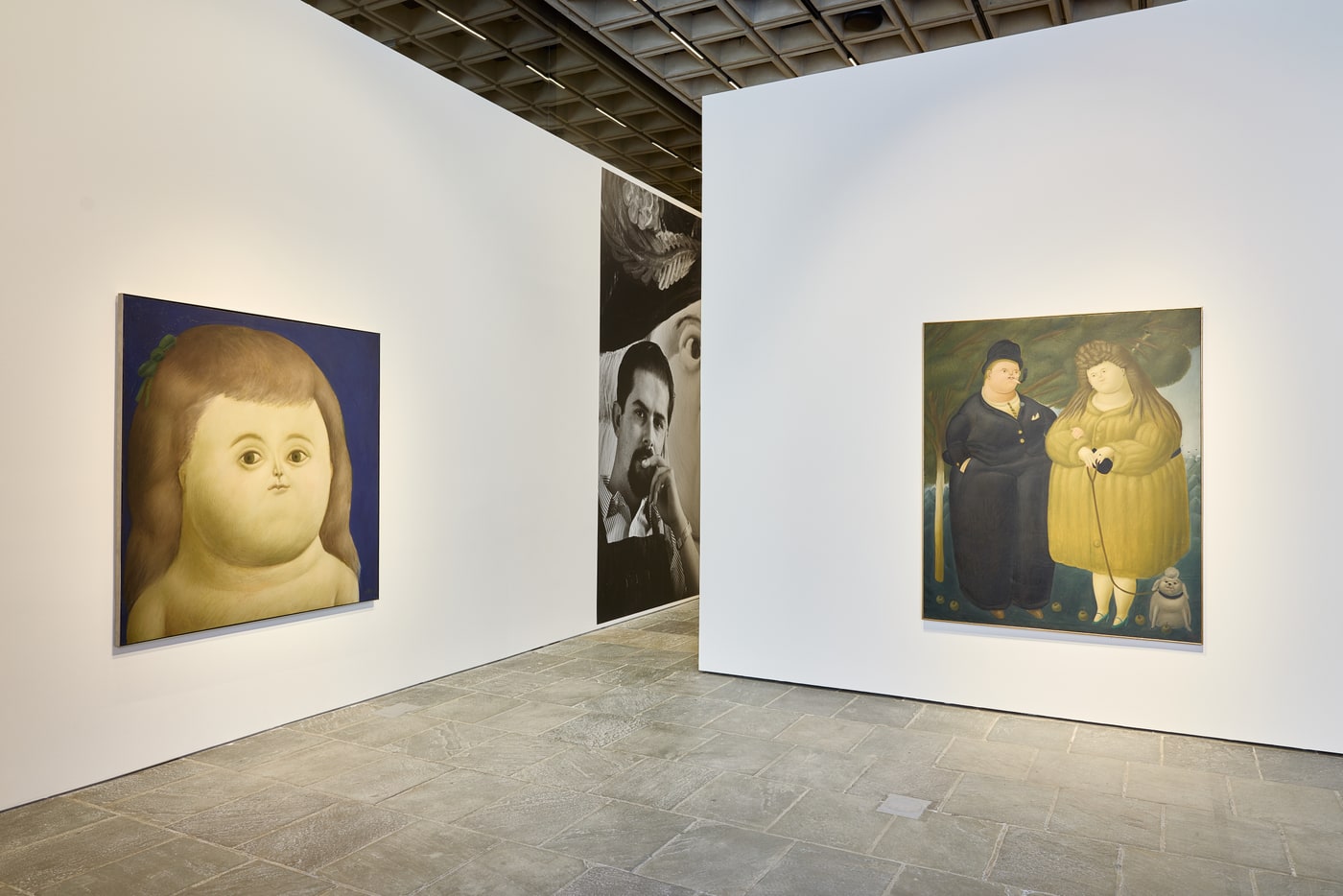
The dialogue with the masters doesn't start in New York. Botero found Velázquez and Goya at the Prado years earlier, Van Gogh somewhere in between. New York is where the conversation goes public. Forget the famous Mona Lisa, Age Twelve. The show has Mona Lisa, Age Thirteen, 1959, never exhibited publicly before. Botero subverts an image already fixed in our collective memory. Her face nearly fills up the canvas. He plays with scale and volume as a way of exaggerating cultural presence and significance. The face is the flattest part of the whole painting. Almost no linework, soft, even colour throughout with a faint darker edge along the jaw to suggest roundness. Restrained to the point of looking almost airbrushed. The clothing is painted the opposite way. It's a striped garment, hard-edged bands of teal and grey, more graphic and pattern-driven than painterly. The hair has a bit more visible brushwork too, especially the bow, with small directional marks giving it texture the face doesn't have. The contrast is stillness and near-total flatness in the face versus pattern and linear activity in the clothes. The effect is that your eye locks onto the face specifically because it's the one area of total calm in an otherwise busy canvas. It's the one thing that still says, Mona Lisa. The face is not just huge; it's that everything around it is more visually active, so the blankness of the face reads as monumental.
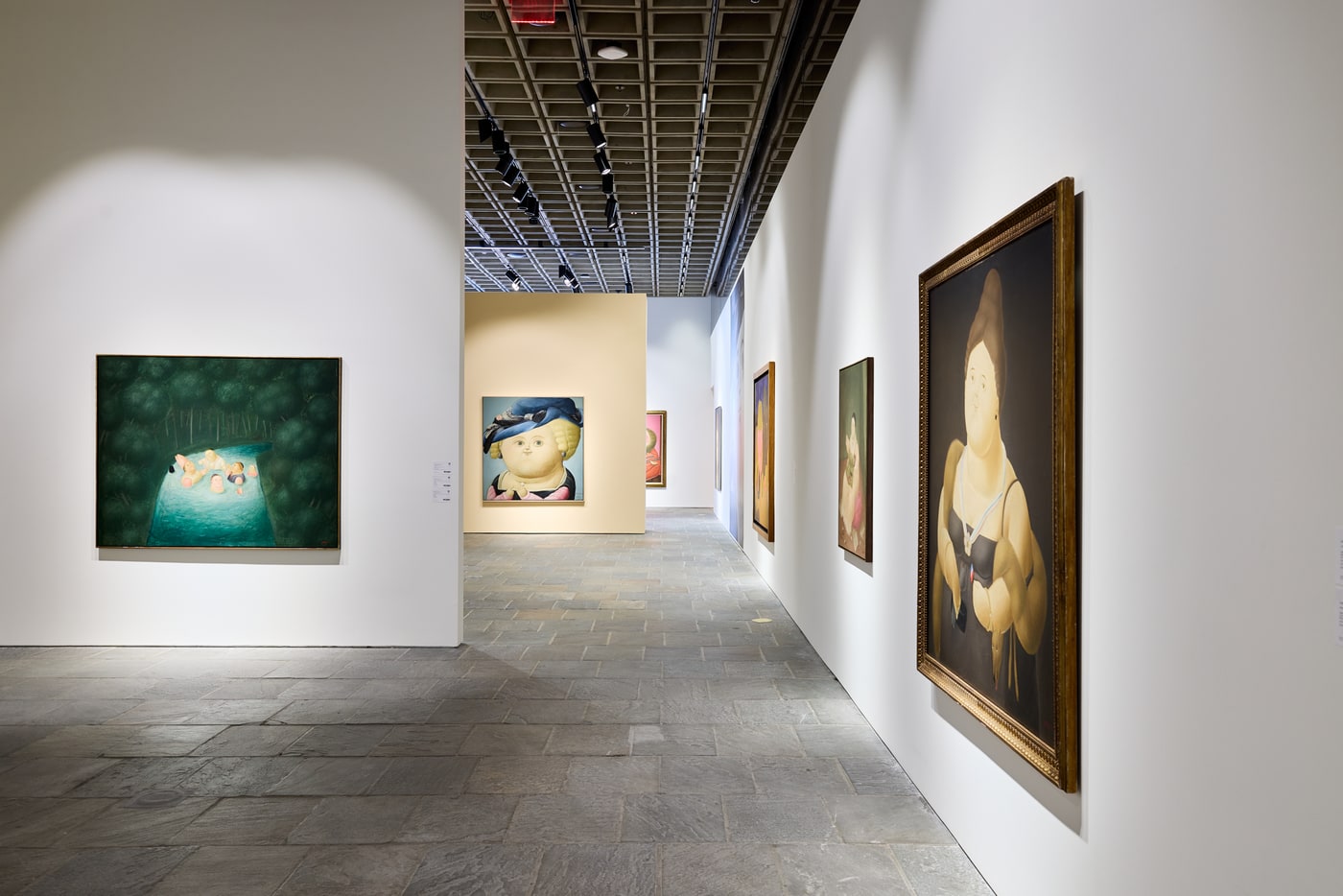
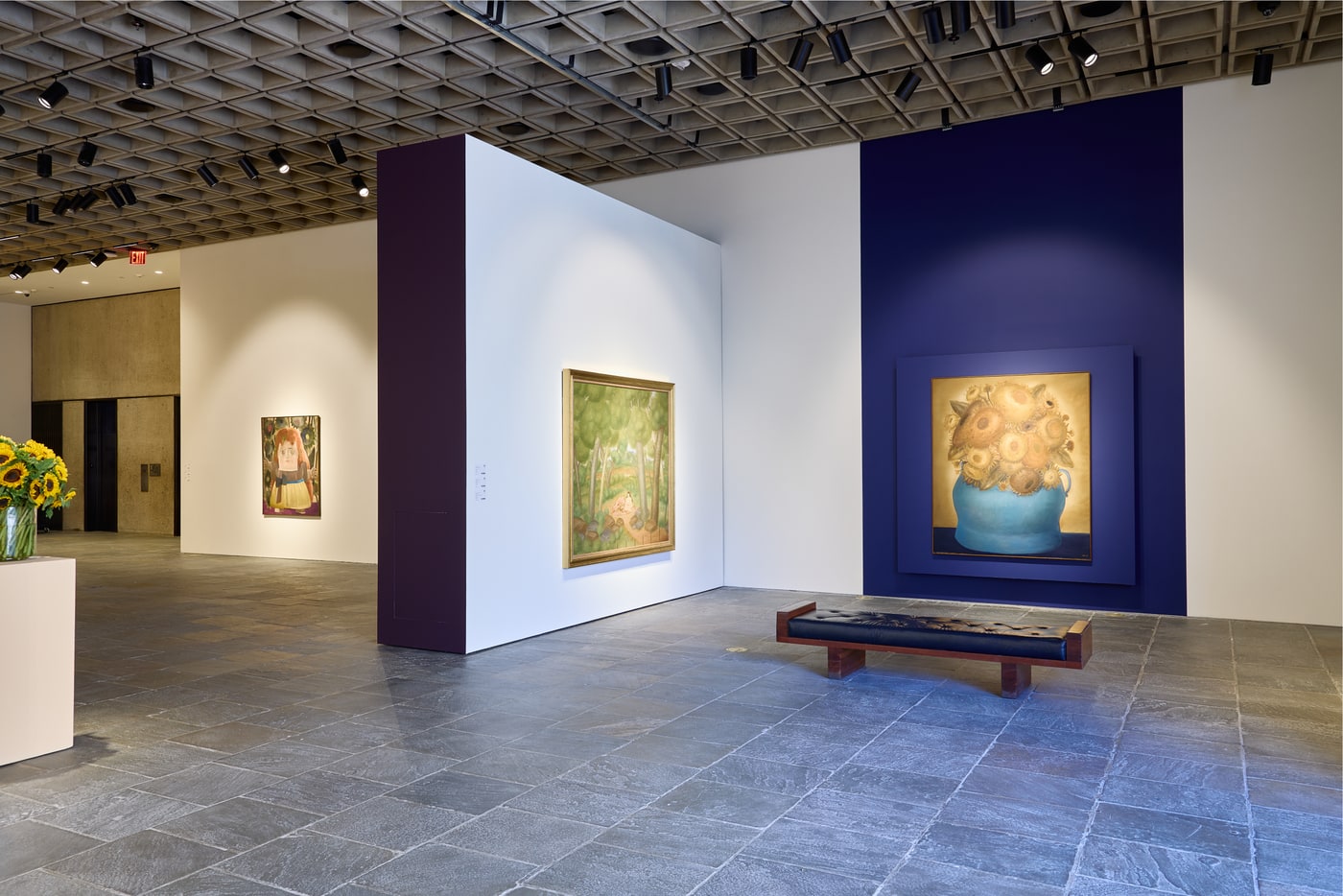
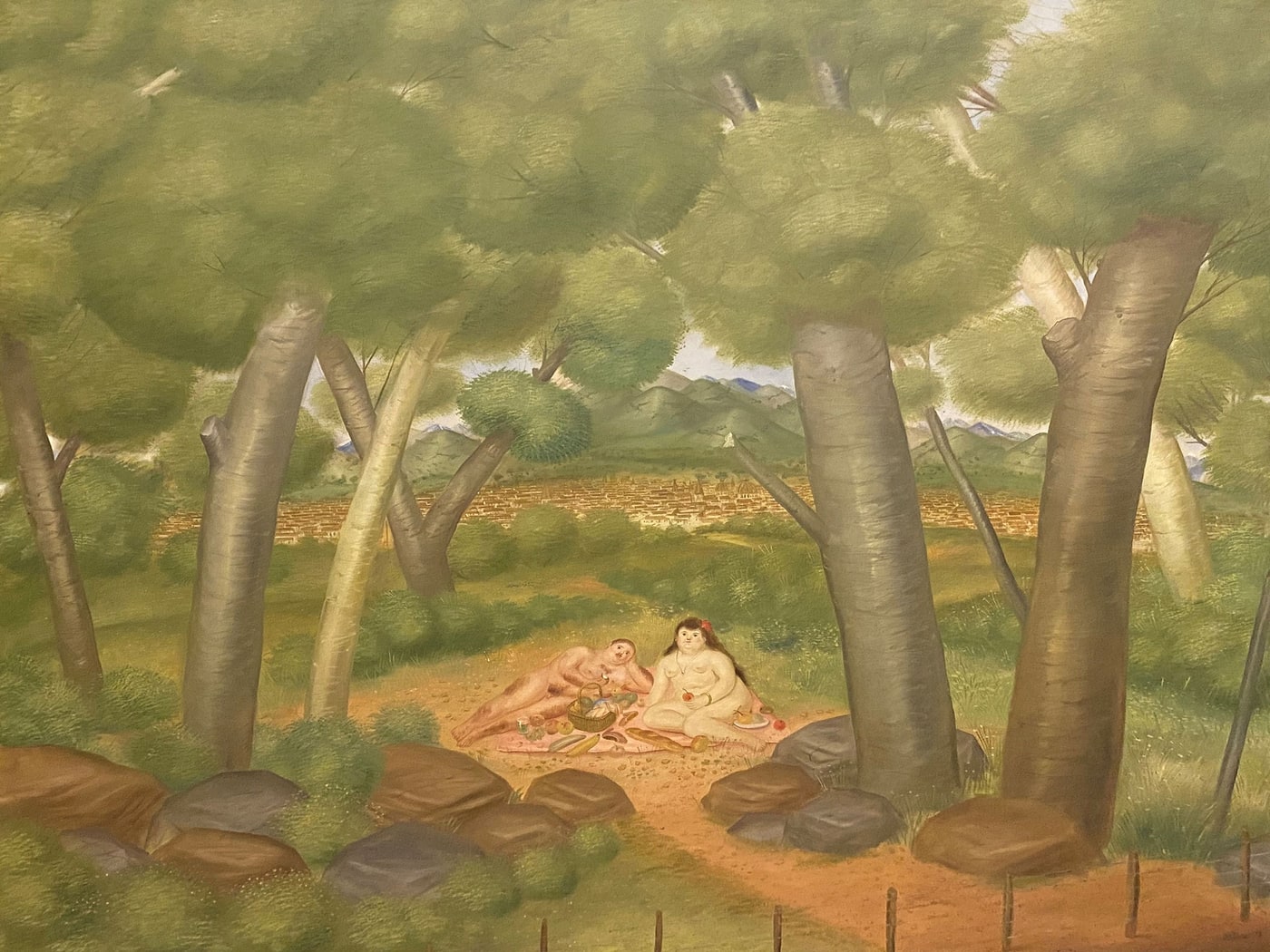
Homenaje a Cézanne, 1963, is a direct reference to Cézanne and not the only one. Cézanne builds mass additively, through small related planes of colour accumulating into form. Botero builds mass the opposite way: one continuous, taut contour, no visible construction. "Homenaje a Cézanne" isn't really an homage in method; its volume is achieved by the reverse technique. Sunflowers, 1977, is dense, structural, and takes up space. Van Gogh's brushstrokes are broad and blunt. You can see the gesture. A record of his hand's urgency, rapid and anxious. Botero erases the gesture. The surface gives no evidence of how it was made. Picnic, 1973, is an obvious homage to Manet. Luncheon on the Grass is a scandal painting; a nude woman's flat, confrontational gaze among clothed men. Does Botero's Picnic preserve that confrontation, or does his rounding defuse it into humour, leisure and ease? Manet's scandal was a scene of leisure that was actually about class, about who gets to be looked at and who does the looking. In Botero's version, the scandal gets absorbed into volume. It's a man and a woman enjoying a picnic in the Colombian countryside. An enormous head against tiny hands: Mrs. Rubens #3, 1964. It plays on disproportion. Peter Paul Rubens already painted bodies this voluptuous. But Rubens' flesh moves, baroque, swirling, always mid-gesture. Botero's is still. Monumental. The volume is inherited. The motion isn't. He keeps the flesh and extracts the movement. El Greco's Portrait of Cardinal Niño de Guevara is elongated into something otherworldly, flickering, almost too spiritually intense to look at directly. Botero's Cardenal (Niño de Guevara), 1964, does the opposite: inflation instead of elongation. Same authority, same institutional weight sitting in the body, but where El Greco stretches the figure toward the divine, Botero grounds him in sheer physical mass. Two opposite techniques, reaching for the same thing.
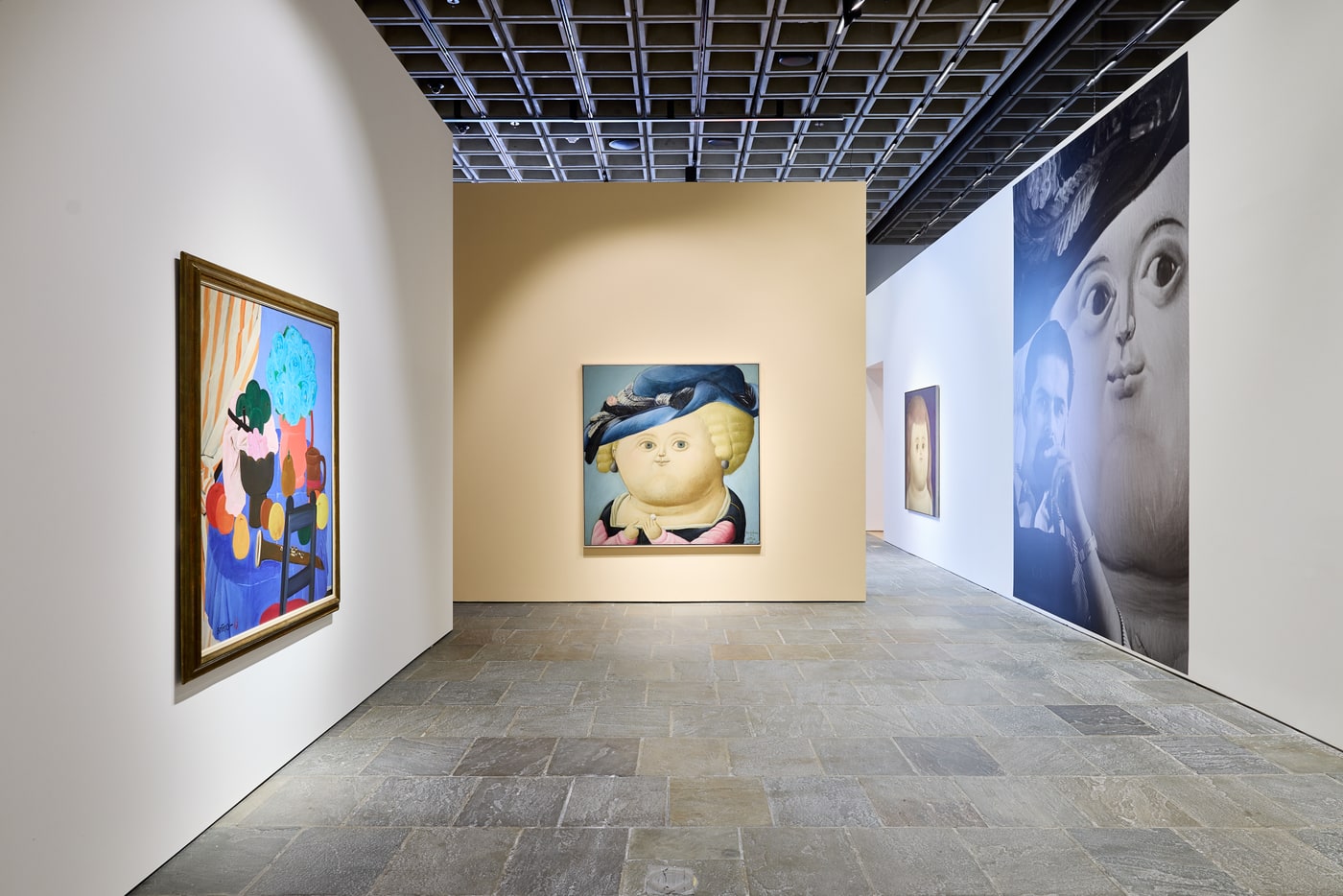
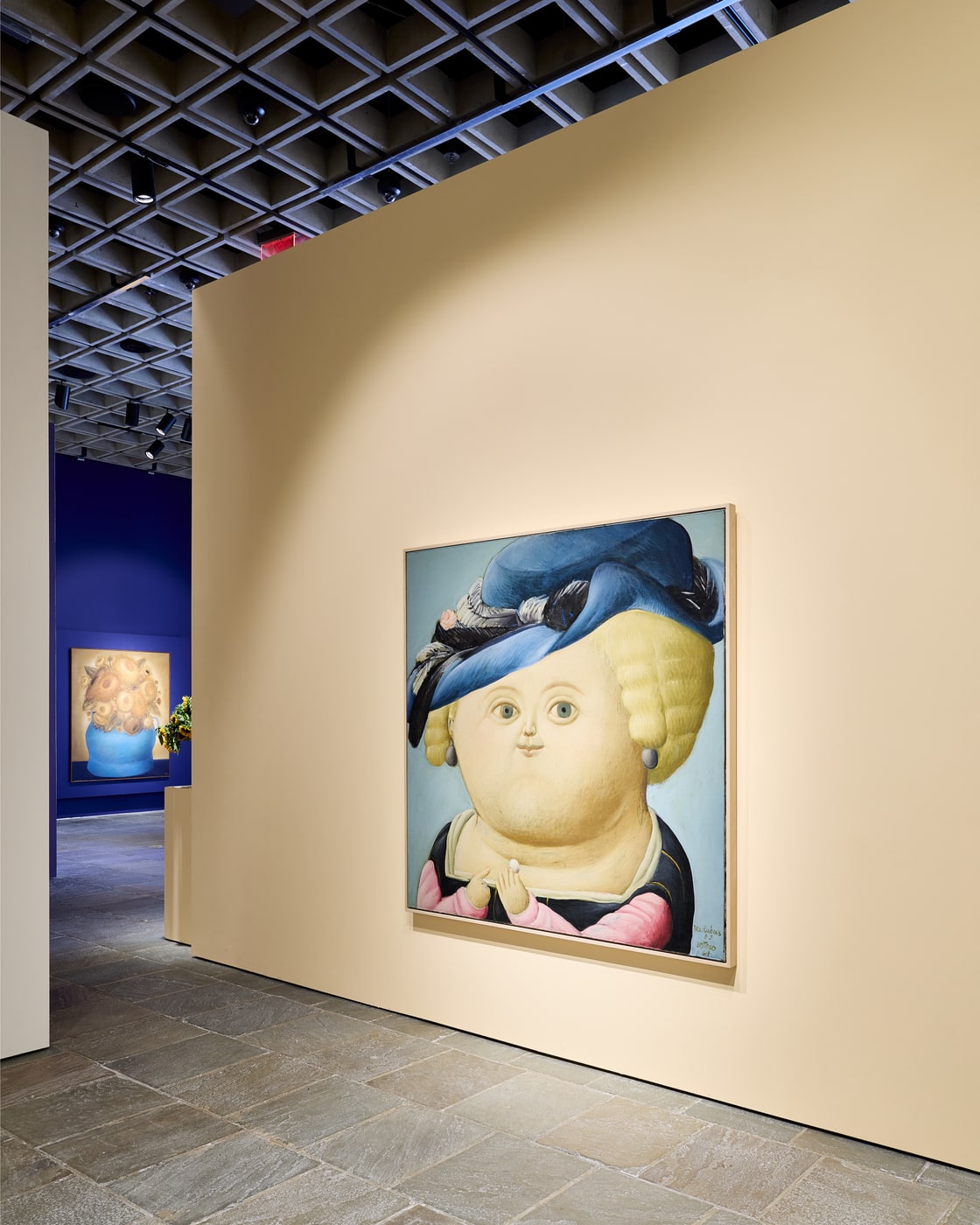
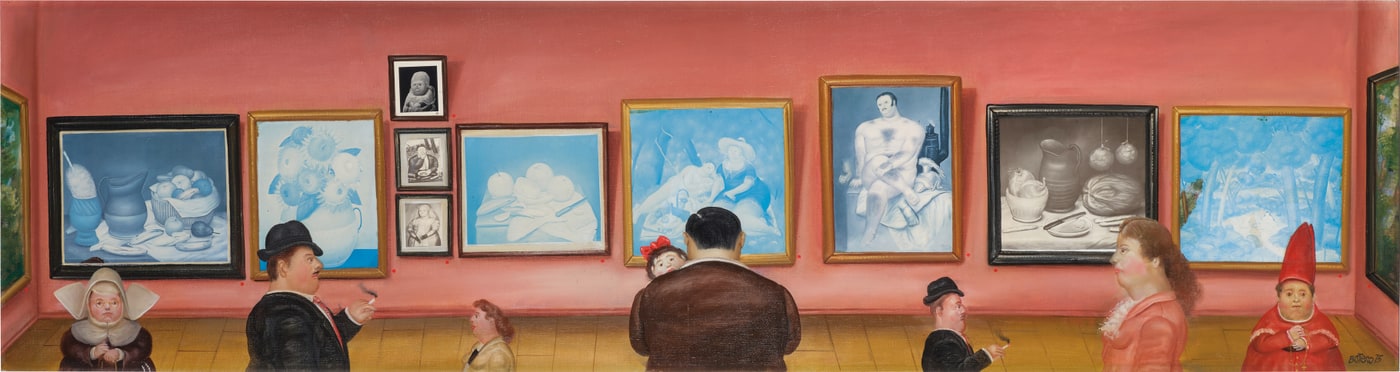
The Botero Exhibition, 1975, is reminiscent of Courbet's The Painter's Studio. Courbet stages himself at the easel surrounded by a cast representing society, an artist making a claim about his own place in the world. The Botero Exhibition does the same rhetorical move. It's not just "reminiscent"; it's Botero borrowing Courbet's specific self-mythologising gesture to stage his own art-historical self-placement. Ten of his own works hang on the gallery wall. They're real reproductions, cut from exhibition catalogues and books. Some are monochrome because the original print was black-and-white. Others have faded to just blue and white ink after decades. His own Sunflowers is up there. So is Pope Leo X (after Raphael). So are two separate homages to Manet, Le déjeuner sur l'herbe, 1969 and Picnic, 1973, both rendered in that same faded blue. Who's looking at them is a cast of Botero's own recurring characters: a nun in a wimple, a bowler-hatted bourgeois man smoking, another man with his back turned holding a doll-like child with a red bow, a woman in a pink coat, and on the far right, in full red robes, a cardinal. Each figure is mirrored by another, matched in scale, except the man at the centre and the young daughter looking over his shoulder, straight out at the viewer, breaking the symmetry everyone else keeps. The Painter's Studio famously stages Courbet at the easel, flanked by two groups: ordinary life on one side, his real friends and patrons on the other, a manifesto about his place between the world and the art world. Botero restages that exact structure but closes the loop. Instead of real acquaintances, the "society" witnessing the work is made up of Botero's own characters, the same cardinal and bourgeois types who populate his other paintings. The blue-monochrome treatment adds another layer. Those works already read as historical, already flattened into reproduction, already museum pieces, while he was still very much alive and painting in 1975.
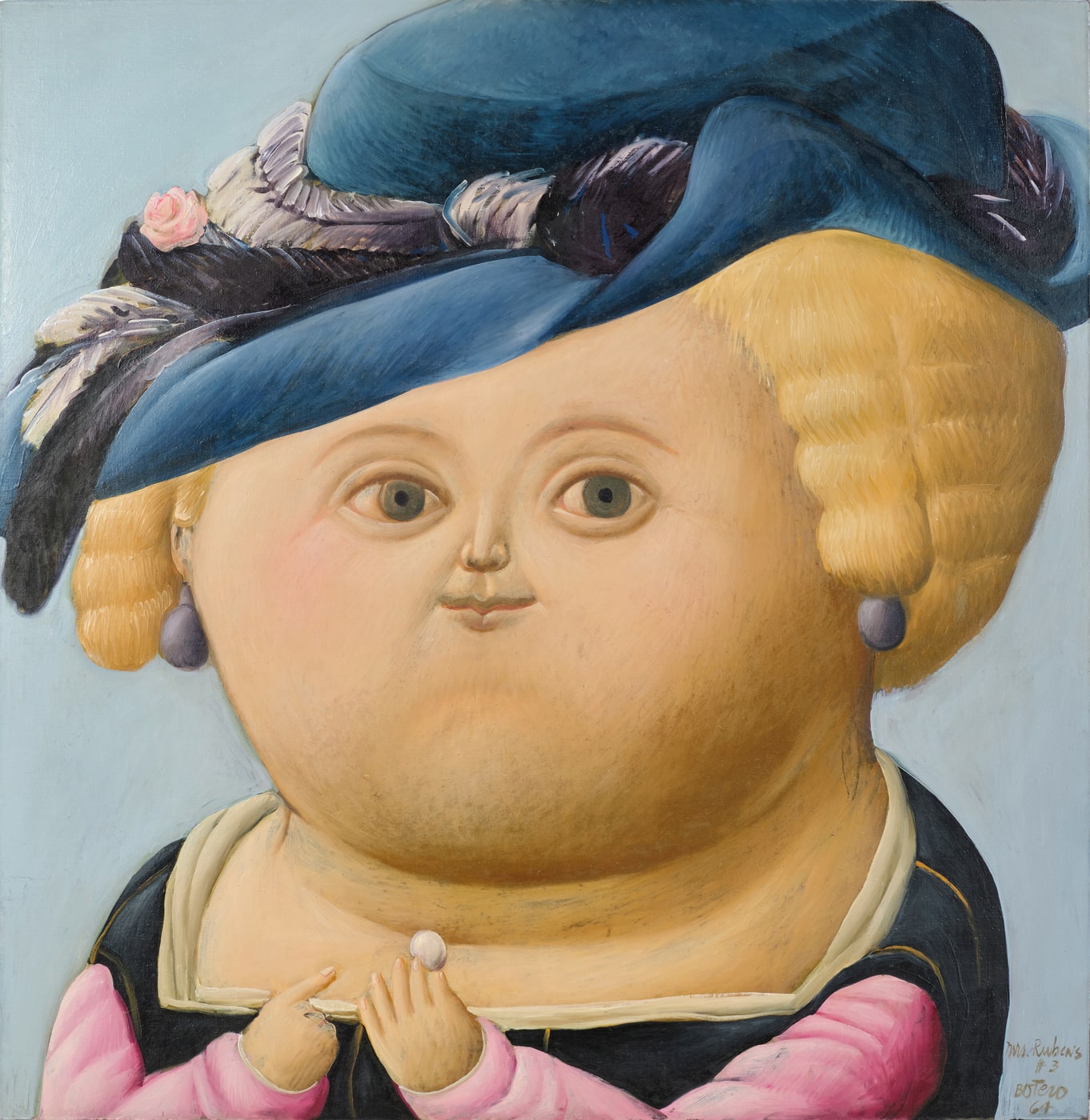
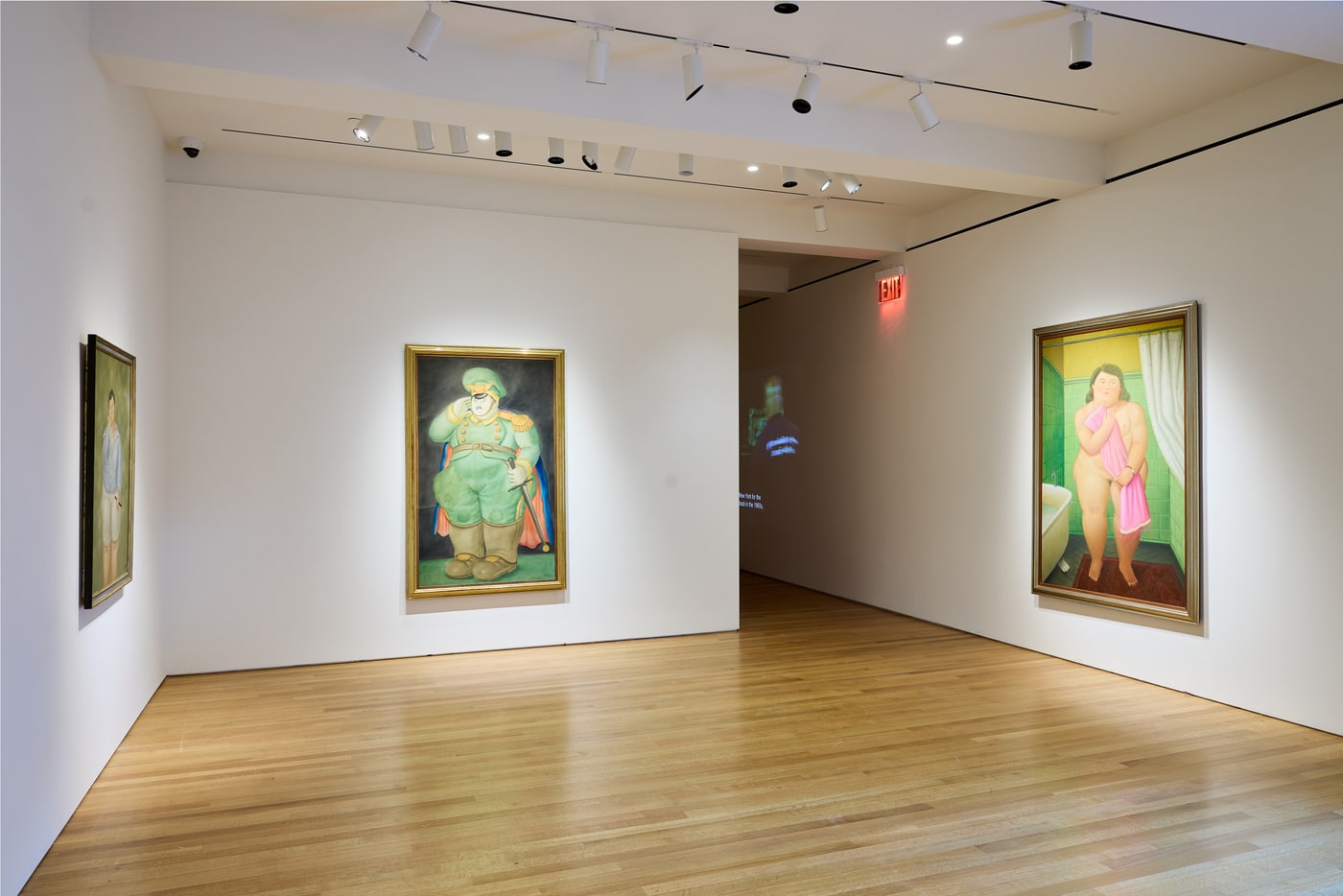
It takes mere seconds to recognise a Botero. Botero wants the viewer to look at everyday objects, a society woman, a puppy in Los Ricos, a cardinal, or a piece of fruit from a new perspective. He paints his subjects in larger-than-life scale with volume and presence. He refines art history from inside it, grounded in reference to the masters, while staying playful and humorous. Cézanne's planes become one unbroken contour. Van Gogh's anxious hand disappears into calm. Rubens' voluptuous bodies in movement get fleshier and fleshier, and stiller and stiller. El Greco's elongation is inflated. Manet's confrontation softens into humour and ease. Even Courbet's whole social manifesto gets restaged with an audience Botero casts himself. He isn't quoting these painters so much as taking the one thing each is known for and doing the opposite, while keeping everything else recognisably theirs. Volume is the one thing that never moves. That's the actual conversation.
Botero in New York, a selling exhibition at Sotheby's, closed last week, carrying on his artistic legacy just three years after his passing on September 15, 2023.
This week on 000.
Shared privately from 000. Want in? Request access at 000.gallery. Follow on Instagram. Questions: support@000.gallery.
Responses.
M · 16 Sept 2026
This is one of my favourites. Thank you for the lovely reminder on Botero.
Meg · 16 Sept 2026
such a beautiful piece
F · 17 Sept 2026
Well written
Anya · 17 Sept 2026
Beautifully curated! Some of the coolest works of Botero 😍